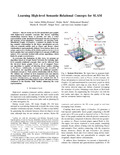
[en] Recent works on SLAM extend their pose graphs
with higher-level semantic concepts like Rooms exploiting
relationships between them, to provide, not only a richer
representation of the situation/environment but also to improve
the accuracy of its estimation. Concretely, our previous work,
Situational Graphs (S-Graphs+), a pioneer in jointly leverag-
ing semantic relationships in the factor optimization process,
relies on semantic entities such as Planes and Rooms, whose
relationship is mathematically defined. Nevertheless, there is no
unique approach to finding all the hidden patterns in lower-level
factor-graphs that correspond to high-level concepts of different
natures. It is currently tackled with ad-hoc algorithms, which
limits its graph expressiveness.
To overcome this limitation, in this work, we propose an
algorithm based on Graph Neural Networks for learning high-
level semantic-relational concepts that can be inferred from
the low-level factor graph. Given a set of mapped Planes
our algorithm is capable of inferring Room entities relating
to the Planes. Additionally, to demonstrate the versatility of
our method, our algorithm can infer an additional semantic-
relational concept, i.e. Wall, and its relationship with its Planes.
We validate our method in both simulated and real datasets
demonstrating improved performance over two baseline ap-
proaches. Furthermore, we integrate our method into the S-
Graphs+ algorithm providing improved pose and map accuracy
compared to the baseline while further enhancing the scene
representation.
Research center :
Interdisciplinary Centre for Security, Reliability and Trust (SnT) > ARG - Automation & Robotics
Disciplines :
Computer science
Author, co-author :
MILLÁN ROMERA, José Andrés ; University of Luxembourg > Interdisciplinary Centre for Security, Reliability and Trust (SNT) > Automation
BAVLE, Hriday ; University of Luxembourg > Interdisciplinary Centre for Security, Reliability and Trust (SNT) > Automation
SHAHEER, Muhammad ; University of Luxembourg > Interdisciplinary Centre for Security, Reliability and Trust (SNT) > Automation
Oswald, Martin R.
VOOS, Holger ; University of Luxembourg > Interdisciplinary Centre for Security, Reliability and Trust (SNT) > Automation
SANCHEZ LOPEZ, Jose Luis ; University of Luxembourg > Interdisciplinary Centre for Security, Reliability and Trust (SNT) > Automation
External co-authors :
yes
Language :
English
Title :
Learning High-level Semantic-Relational Concepts for SLAM
Publication date :
2023
Event name :
2024 International Conference on Intelligent Robots and Systems (IROS 2024)
Event organizer :
IEEE/RSJ
Event place :
Abu Dhabi, United Arab Emirates
Event date :
14/10/2024 - 18/10/2024
Audience :
International
Journal title :
IEEE International Conference on Intelligent Robots and Systems
ISSN :
2153-0858
Publisher :
Institute of Electrical and Electronics Engineers, New York, United States - New York
Pages :
8
Peer reviewed :
Peer Reviewed verified by ORBi
Focus Area :
Computational Sciences
Development Goals :
9. Industry, innovation and infrastructure
FnR Project :
FNR17097684 - Robotic Situational Awareness By Understanding And Reasoning, 2022 (15/09/2022-14/09/2026) - José Andrés Millán Romera