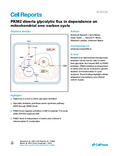
[en] Modeling tumor metabolism in vitro remains challenging. Here, we used galactose as an in vitro tool compound to mimic glycolytic limitation. In contrast to the established idea that high glycolytic flux reduces pyruvate kinase isozyme M2 (PKM2) activity to support anabolic processes, we have discovered that glycolytic limitation also affects PKM2 activity. Surprisingly, despite limited carbon availability and energetic stress, cells induce a near-complete block of PKM2 to divert carbons toward serine metabolism. Simultaneously, TCA cycle flux is sustained, and oxygen consumption is increased, supported by glutamine. Glutamine not only supports TCA cycle flux but also serine synthesis via distinct mechanisms that are directed through PKM2 inhibition. Finally, deleting mitochondrial one-carbon (1C) cycle reversed the PKM2 block, suggesting a potential formate-dependent crosstalk that coordinates mitochondrial 1C flux and cytosolic glycolysis to support cell survival and proliferation during nutrient-scarce conditions.
Disciplines :
Biochemistry, biophysics & molecular biology
Author, co-author :
BENZARTI, Mohaned ; University of Luxembourg > Faculty of Science, Technology and Medicine (FSTM) > Department of Life Sciences and Medicine (DLSM)
NEISES, Laura ; University of Luxembourg > Luxembourg Centre for Systems Biomedicine > Molecular and Functional Neurobiology > Team Anne GRÜNEWALD ; Cancer Metabolism Group, Department of Cancer Research, Luxembourg Institute of Health, Luxembourg, Luxembourg
Oudin, Anais; NORLUX Neuro-Oncology Laboratory, Department of Cancer Research, Luxembourg Institute of Health, Luxembourg, Luxembourg
Krötz, Christina; Cancer Metabolism Group, Department of Cancer Research, Luxembourg Institute of Health, Luxembourg, Luxembourg
VIRY, Elodie ; University of Luxembourg > Faculty of Science, Technology and Medicine > Department of Life Sciences and Medicine > Team Serge HAAN ; Tumor Stroma Interactions, Department of Cancer Research, Luxembourg Institute of Health, Luxembourg, Luxembourg
Gargiulo, Ernesto; Tumor Stroma Interactions, Department of Cancer Research, Luxembourg Institute of Health, Luxembourg, Luxembourg
Pulido, Coralie; Animal Facility, Department of Cancer Research, Luxembourg Institute of Health, Luxembourg, Luxembourg
SCHMOETTEN, Maryse ; University of Luxembourg > Faculty of Science, Technology and Medicine > Department of Life Sciences and Medicine > Team Elisabeth LETELLIER
POZDEEV, Vitaly ; University of Luxembourg > Faculty of Science, Technology and Medicine (FSTM) > Department of Life Sciences and Medicine (DLSM)
Lorenz, Nadia I; Dr. Senckenberg Institute of Neurooncology, University Hospital Frankfurt, Goethe University, Frankfurt am Main, Germany, German Cancer Consortium, Partner Site Frankfurt/Mainz, Frankfurt am Main, Germany, Frankfurt Cancer Institute (FCI), University Hospital Frankfurt, Goethe University, Frankfurt am Main, Germany, University Cancer Center Frankfurt (UCT), University Hospital Frankfurt, Goethe University, Frankfurt am Main, Germany
Ronellenfitsch, Michael W; Dr. Senckenberg Institute of Neurooncology, University Hospital Frankfurt, Goethe University, Frankfurt am Main, Germany, German Cancer Consortium, Partner Site Frankfurt/Mainz, Frankfurt am Main, Germany, Frankfurt Cancer Institute (FCI), University Hospital Frankfurt, Goethe University, Frankfurt am Main, Germany, University Cancer Center Frankfurt (UCT), University Hospital Frankfurt, Goethe University, Frankfurt am Main, Germany
Sumpton, David; Cancer Research U.K. Scotland Institute, Switchback Road, Bearsden, Glasgow G61 1BD, UK
WARMOES, Marc Omer ; University of Luxembourg > Luxembourg Centre for Systems Biomedicine > Scientific Central Services > Metabolomics Platform
Jaeger, Christian; Metabolomics Platform, Luxembourg Centre for Systems Biomedicine, University of Luxembourg, Belvaux, Luxembourg
Lesur, Antoine; Cancer Metabolism Group, Department of Cancer Research, Luxembourg Institute of Health, Luxembourg, Luxembourg
Becker, Björn; Cancer Metabolism Group, Department of Cancer Research, Luxembourg Institute of Health, Luxembourg, Luxembourg
MOUSSAY, Etienne ; University of Luxembourg ; Tumor Stroma Interactions, Department of Cancer Research, Luxembourg Institute of Health, Luxembourg, Luxembourg
PAGGETTI, Jerome ; University of Luxembourg ; Tumor Stroma Interactions, Department of Cancer Research, Luxembourg Institute of Health, Luxembourg, Luxembourg
NICLOU, Simone P. ; University of Luxembourg > Faculty of Science, Technology and Medicine (FSTM) > Department of Life Sciences and Medicine (DLSM)
LETELLIER, Elisabeth ; University of Luxembourg > Faculty of Science, Technology and Medicine (FSTM) > Department of Life Sciences and Medicine (DLSM)
MEISER, Johannes ; University of Luxembourg ; Cancer Metabolism Group, Department of Cancer Research, Luxembourg Institute of Health, Luxembourg, Luxembourg. Electronic address: johannes.meiser@lih.lu
M.B. is supported by the Fondation du Pélican de Mie et Pierre Hippert-Faber , under the aegis of the Fondation de Luxembourg . M.B. and J.M. are supported by the Luxembourg National Research Fund (FNR) ATTRACT program ( A18/BM/11809970 ). M.B., J.M., and E.L. are supported by FNR-CORE grant ( C21/BM/15718879/1cFlex ). E.L. is supported by the FNR-CORE program ( C16/BM/11282028 and C20/BM/14591557 ), by a Proof of Concept FNR grant ( PoC/18/12554295 ), a PRIDE17/11823097 , and by i2Tron ( PRIDE19/14254520 ). E.G., J.P., and E.M. are supported by grants from the FNR and Fondation Cancer ( PRIDE15/10675146/CANBIO , C20/BM/14582635 , and C20/BM/14592342 ). E.V. is supported by FNRS-Télévie ( 7.4509.20 and 7.4572.22 ).We are grateful to Stephanie Kreis (University of Luxembourg) for providing us with B16-F10, A375, and SKMeL28 cells; Clement Thomas (LIH, Luxembourg) for providing 4T1 and BT-20 cells; Lewis Cantley (Harvard Medical School) for providing MDA-MB-468 WT and MTHFD1LKO cells; and Dimitar Efremov (ICGEB, Trieste) for providing TCL1-355 cells. We are grateful for all the technical and analytical support from the different metabolomics platforms toward the work presented here and, in specific, Francois Bernardin from the metabolomics platform at LIH, and Xiangyi Dong, Floriane Gavotto, and Lucia Gallucci from the LCSB Metabolomics Platform (RRID:SCR 024769). We are thankful for the support of the National Cytometry Platform (Quantitative Biology Unit, LIH) for support with flow cytometry measurements and analysis. Figures 1A, 1B, 3K, 5A, 5H, 6A and 7A were created with BioRender.com. M.B. is supported by the Fondation du Pélican de Mie et Pierre Hippert-Faber, under the aegis of the Fondation de Luxembourg. M.B. and J.M. are supported by the Luxembourg National Research Fund (FNR) ATTRACT program (A18/BM/11809970). M.B. J.M. and E.L. are supported by FNR-CORE grant (C21/BM/15718879/1cFlex). E.L. is supported by the FNR-CORE program (C16/BM/11282028 and C20/BM/14591557), by a Proof of Concept FNR grant (PoC/18/12554295), a PRIDE17/11823097, and by i2Tron (PRIDE19/14254520). E.G. J.P. and E.M. are supported by grants from the FNR and Fondation Cancer (PRIDE15/10675146/CANBIO, C20/BM/14582635, and C20/BM/14592342). E.V. is supported by FNRS-Télévie (7.4509.20 and 7.4572.22). M.B. and J.M. conceptualized and designed the study. M.B. L.N. C.K. and B.B. performed all of the in vitro experiments. A.O. E.V. E.G. V.P. M.S. C.P. J.P. E.M. S.P.N. and E.L. assisted in the design and performing of the in vivo work. L.N. N.I.L. and M.W.R. aided in the generation of different KO cell lines used. D.S. M.W. C.J. and A.L. performed YSI, LC-MS, GC-MS, and IC-MS measurements, while M.B. performed the corresponding data analysis according to instructions from D.S. M.W. C.J. A.L. and J.M. Original draft was written by M.B. and J.M. Review and editing was done by all authors. The authors of the presented study declare no competing interests.
Osthus, R.C., Shim, H., Kim, S., Li, Q., Reddy, R., Mukherjee, M., Xu, Y., Wonsey, D., Lee, L.A., Dang, C.V., Deregulation of glucose transporter 1 and glycolytic gene expression by c-Myc. J. Biol. Chem. 275 (2000), 21797–21800, 10.1074/jbc.C000023200.
Vazquez, A., Liu, J., Zhou, Y., Oltvai, Z.N., Catabolic efficiency of aerobic glycolysis: The Warburg effect revisited. BMC Syst. Biol., 4, 2010, 58, 10.1186/1752-0509-4-58.
Ying, H., Kimmelman, A.C., Lyssiotis, C.A., Hua, S., Chu, G.C., Fletcher-Sananikone, E., Locasale, J.W., Son, J., Zhang, H., Coloff, J.L., et al. Oncogenic Kras maintains pancreatic tumors through regulation of anabolic glucose metabolism. Cell 149 (2012), 656–670, 10.1016/j.cell.2012.01.058.
de Alteriis, E., Cartenì, F., Parascandola, P., Serpa, J., Mazzoleni, S., Revisiting the Crabtree/Warburg effect in a dynamic perspective: a fitness advantage against sugar-induced cell death. Cell Cycle 17 (2018), 688–701, 10.1080/15384101.2018.1442622.
Luengo, A., Li, Z., Gui, D.Y., Sullivan, L.B., Zagorulya, M., Do, B.T., Ferreira, R., Naamati, A., Ali, A., Lewis, C.A., et al. Increased demand for NAD(+) relative to ATP drives aerobic glycolysis. Mol. Cell 81 (2021), 691–707.e6, 10.1016/j.molcel.2020.12.012.
Wang, Y., Stancliffe, E., Fowle-Grider, R., Wang, R., Wang, C., Schwaiger-Haber, M., Shriver, L.P., Patti, G.J., Saturation of the mitochondrial NADH shuttles drives aerobic glycolysis in proliferating cells. Mol. Cell 82 (2022), 3270–3283.e9, 10.1016/j.molcel.2022.07.007.
Bergers, G., Fendt, S.M., The metabolism of cancer cells during metastasis. Nat. Rev. Cancer 21 (2021), 162–180, 10.1038/s41568-020-00320-2.
Fendt, S.-M., Frezza, C., Erez, A., Targeting Metabolic Plasticity and Flexibility Dynamics for Cancer Therapy. Cancer Discov. 10 (2020), 1797–1807, 10.1158/2159-8290.Cd-20-0844.
Cantor, J.R., The Rise of Physiologic Media. Trends Cell Biol. 29 (2019), 854–861, 10.1016/j.tcb.2019.08.009.
Díaz-Ruiz, R., Avéret, N., Araiza, D., Pinson, B., Uribe-Carvajal, S., Devin, A., Rigoulet, M., Mitochondrial oxidative phosphorylation is regulated by fructose 1,6-bisphosphate. A possible role in Crabtree effect induction?. J. Biol. Chem. 283 (2008), 26948–26955, 10.1074/jbc.M800408200.
Holden, H.M., Rayment, I., Thoden, J.B., Structure and function of enzymes of the Leloir pathway for galactose metabolism. J. Biol. Chem. 278 (2003), 43885–43888, 10.1074/jbc.R300025200.
Rempel, A., Mathupala, S.P., Griffin, C.A., Hawkins, A.L., Pedersen, P.L., Glucose catabolism in cancer cells: amplification of the gene encoding type II hexokinase. Cancer Res. 56 (1996), 2468–2471.
Wilson, J.E., Isozymes of mammalian hexokinase: structure, subcellular localization and metabolic function. J. Exp. Biol. 206 (2003), 2049–2057, 10.1242/jeb.00241.
Timson, D.J., Reece, R.J., Functional analysis of disease-causing mutations in human galactokinase. Eur. J. Biochem. 270 (2003), 1767–1774, 10.1046/j.1432-1033.2003.03538.x.
Sullivan, M.R., Danai, L.V., Lewis, C.A., Chan, S.H., Gui, D.Y., Kunchok, T., Dennstedt, E.A., Vander Heiden, M.G., Muir, A., Quantification of microenvironmental metabolites in murine cancers reveals determinants of tumor nutrient availability. Elife, 8, 2019, e44235, 10.7554/eLife.44235.
Reinfeld, B.I., Madden, M.Z., Wolf, M.M., Chytil, A., Bader, J.E., Patterson, A.R., Sugiura, A., Cohen, A.S., Ali, A., Do, B.T., et al. Cell-programmed nutrient partitioning in the tumour microenvironment. Nature 593 (2021), 282–288, 10.1038/s41586-021-03442-1.
Meiser, J., Tumanov, S., Maddocks, O., Labuschagne, C.F., Athineos, D., Van Den Broek, N., Mackay, G.M., Gottlieb, E., Blyth, K., Vousden, K., et al. Serine one-carbon catabolism with formate overflow. Sci. Adv., 2, 2016, e1601273, 10.1126/sciadv.1601273.
Benzarti, M., Delbrouck, C., Neises, L., Kiweler, N., Meiser, J., Metabolic Potential of Cancer Cells in Context of the Metastatic Cascade. Cells, 9, 2020, 10.3390/cells9092035.
Kiweler, N., Delbrouck, C., Pozdeev, V.I., Neises, L., Soriano-Baguet, L., Eiden, K., Xian, F., Benzarti, M., Haase, L., Koncina, E., et al. Mitochondria preserve an autarkic one-carbon cycle to confer growth-independent cancer cell migration and metastasis. Nat. Commun., 13, 2022, 2699, 10.1038/s41467-022-30363-y.
Hyroššová, P., Aragó, M., Moreno-Felici, J., Fu, X., Mendez-Lucas, A., García-Rovés, P.M., Burgess, S., Figueras, A., Viñals, F., Perales, J.C., PEPCK-M recoups tumor cell anabolic potential in a PKC-ζ-dependent manner. Cancer Metabol., 9, 2021, 1, 10.1186/s40170-020-00236-3.
Keshet, R., Lee, J.S., Adler, L., Iraqi, M., Ariav, Y., Lim, L.Q.J., Lerner, S., Rabinovich, S., Oren, R., Katzir, R., et al. Targeting purine synthesis in ASS1-expressing tumors enhances the response to immune checkpoint inhibitors. Nat. Can. (Ott.) 1 (2020), 894–908, 10.1038/s43018-020-0106-7.
Leithner, K., Hrzenjak, A., Trötzmüller, M., Moustafa, T., Köfeler, H.C., Wohlkoenig, C., Stacher, E., Lindenmann, J., Harris, A.L., Olschewski, A., Olschewski, H., PCK2 activation mediates an adaptive response to glucose depletion in lung cancer. Oncogene 34 (2015), 1044–1050, 10.1038/onc.2014.47.
Yang, C., Ko, B., Hensley, C.T., Jiang, L., Wasti, A.T., Kim, J., Sudderth, J., Calvaruso, M.A., Lumata, L., Mitsche, M., et al. Glutamine oxidation maintains the TCA cycle and cell survival during impaired mitochondrial pyruvate transport. Mol. Cell 56 (2014), 414–424, 10.1016/j.molcel.2014.09.025.
Lyssiotis, C.A., Kimmelman, A.C., Metabolic Interactions in the Tumor Microenvironment. Trends Cell Biol. 27 (2017), 863–875, 10.1016/j.tcb.2017.06.003.
Hui, S., Ghergurovich, J.M., Morscher, R.J., Jang, C., Teng, X., Lu, W., Esparza, L.A., Reya, T., Le, Z., Yanxiang Guo, J., et al. Glucose feeds the TCA cycle via circulating lactate. Nature 551 (2017), 115–118, 10.1038/nature24057.
Faubert, B., Li, K.Y., Cai, L., Hensley, C.T., Kim, J., Zacharias, L.G., Yang, C., Do, Q.N., Doucette, S., Burguete, D., et al. Lactate Metabolism in Human Lung Tumors. Cell 171 (2017), 358–371.e9, 10.1016/j.cell.2017.09.019.
Cheung, S.M., Husain, E., Masannat, Y., Miller, I.D., Wahle, K., Heys, S.D., He, J., Lactate concentration in breast cancer using advanced magnetic resonance spectroscopy. Br. J. Cancer 123 (2020), 261–267, 10.1038/s41416-020-0886-7.
Leithner, K., Triebl, A., Trötzmüller, M., Hinteregger, B., Leko, P., Wieser, B.I., Grasmann, G., Bertsch, A.L., Züllig, T., Stacher, E., et al. The glycerol backbone of phospholipids derives from noncarbohydrate precursors in starved lung cancer cells. Proc. Natl. Acad. Sci. USA 115 (2018), 6225–6230, 10.1073/pnas.1719871115.
Vande Voorde, J., Ackermann, T., Pfetzer, N., Sumpton, D., Mackay, G., Kalna, G., Nixon, C., Blyth, K., Gottlieb, E., Tardito, S., Improving the metabolic fidelity of cancer models with a physiological cell culture medium. Sci. Adv., 5, 2019, eaau7314, 10.1126/sciadv.aau7314.
Diehl, F.F., Lewis, C.A., Fiske, B.P., Vander Heiden, M.G., Cellular redox state constrains serine synthesis and nucleotide production to impact cell proliferation. Nat. Metab. 1 (2019), 861–867, 10.1038/s42255-019-0108-x.
Lemaigre, F.P., Rousseau, G.G., Transcriptional control of genes that regulate glycolysis and gluconeogenesis in adult liver. Biochem. J. 303 (1994), 1–14, 10.1042/bj3030001.
Anastasiou, D., Yu, Y., Israelsen, W.J., Jiang, J.K., Boxer, M.B., Hong, B.S., Tempel, W., Dimov, S., Shen, M., Jha, A., et al. Pyruvate kinase M2 activators promote tetramer formation and suppress tumorigenesis. Nat. Chem. Biol. 8 (2012), 839–847, 10.1038/nchembio.1060.
Dayton, T.L., Jacks, T., Vander Heiden, M.G., PKM2, cancer metabolism, and the road ahead. EMBO Rep. 17 (2016), 1721–1730, 10.15252/embr.201643300.
Bond, C.J., Jurica, M.S., Mesecar, A., Stoddard, B.L., Determinants of allosteric activation of yeast pyruvate kinase and identification of novel effectors using computational screening. Biochemistry 39 (2000), 15333–15343, 10.1021/bi001443i.
Anastasiou, D., Poulogiannis, G., Asara, J.M., Boxer, M.B., Jiang, J.K., Shen, M., Bellinger, G., Sasaki, A.T., Locasale, J.W., Auld, D.S., et al. Inhibition of pyruvate kinase M2 by reactive oxygen species contributes to cellular antioxidant responses. Science 334 (2011), 1278–1283, 10.1126/science.1211485.
Chaneton, B., Hillmann, P., Zheng, L., Martin, A.C.L., Maddocks, O.D.K., Chokkathukalam, A., Coyle, J.E., Jankevics, A., Holding, F.P., Vousden, K.H., et al. Serine is a natural ligand and allosteric activator of pyruvate kinase M2. Nature 491 (2012), 458–462, 10.1038/nature11540.
Weinstabl, H., Treu, M., Rinnenthal, J., Zahn, S.K., Ettmayer, P., Bader, G., Dahmann, G., Kessler, D., Rumpel, K., Mischerikow, N., et al. Intracellular Trapping of the Selective Phosphoglycerate Dehydrogenase (PHGDH) Inhibitor BI-4924 Disrupts Serine Biosynthesis. J. Med. Chem. 62 (2019), 7976–7997, 10.1021/acs.jmedchem.9b00718.
Smith, G.K., Banks, S.D., Monaco, T.J., Rigual, R., Duch, D.S., Mullin, R.J., Huber, B.E., Activity of an NAD-dependent 5,10-methylenetetrahydrofolate dehydrogenase in normal tissue, neoplastic cells, and oncogene-transformed cells. Arch. Biochem. Biophys. 283 (1990), 367–371, 10.1016/0003-9861(90)90656-j.
Lorenz, N.I., Sauer, B., Zeiner, P.S., Strecker, M.I., Luger, A.-L., Schulte, D., Mittelbronn, M., Alekseeva, T., Sevenich, L., Harter, P.N., et al. AMP-kinase mediates adaptation of glioblastoma cells to conditions of the tumour microenvironment. Preprint at bioRxiv, 2022, 10.1101/2022.03.25.485624.
Bichi, R., Shinton, S.A., Martin, E.S., Koval, A., Calin, G.A., Cesari, R., Russo, G., Hardy, R.R., Croce, C.M., Human chronic lymphocytic leukemia modeled in mouse by targeted TCL1 expression. Proc. Natl. Acad. Sci. USA 99 (2002), 6955–6960, 10.1073/pnas.102181599.
Chakraborty, S., Martines, C., Porro, F., Fortunati, I., Bonato, A., Dimishkovska, M., Piazza, S., Yadav, B.S., Innocenti, I., Fazio, R., et al. B-cell receptor signaling and genetic lesions in TP53 and CDKN2A/CDKN2B cooperate in Richter transformation. Blood 138 (2021), 1053–1066, 10.1182/blood.2020008276.
Nelson, D.L.a., Lehninger Principles of Biochemistry. 2017, Macmillan Higher Education.
Ye, J., Mancuso, A., Tong, X., Ward, P.S., Fan, J., Rabinowitz, J.D., Thompson, C.B., Pyruvate kinase M2 promotes de novo serine synthesis to sustain mTORC1 activity and cell proliferation. Proc. Natl. Acad. Sci. USA 109 (2012), 6904–6909, 10.1073/pnas.1204176109.
Rossi, M., Altea-Manzano, P., Demicco, M., Doglioni, G., Bornes, L., Fukano, M., Vandekeere, A., Cuadros, A.M., Fernández-García, J., Riera-Domingo, C., et al. PHGDH heterogeneity potentiates cancer cell dissemination and metastasis. Nature 605 (2022), 747–753, 10.1038/s41586-022-04758-2.
Muir, A., Vander Heiden, M.G., The nutrient environment affects therapy. Science 360 (2018), 962–963, 10.1126/science.aar5986.
Hiller, K., Hangebrauk, J., Jäger, C., Spura, J., Schreiber, K., Schomburg, D., MetaboliteDetector: comprehensive analysis tool for targeted and nontargeted GC/MS based metabolome analysis. Anal. Chem. 81 (2009), 3429–3439, 10.1021/ac802689c.
Rattigan, K.M., Brabcova, Z., Sarnello, D., Zarou, M.M., Roy, K., Kwan, R., de Beauchamp, L., Dawson, A., Ianniciello, A., Khalaf, A., et al. Pyruvate anaplerosis is a targetable vulnerability in persistent leukaemic stem cells. Nat. Commun., 14, 2023, 4634, 10.1038/s41467-023-40222-z.
Wang, T., Gnanaprakasam, J.N.R., Chen, X., Kang, S., Xu, X., Sun, H., Liu, L., Rodgers, H., Miller, E., Cassel, T.A., et al. Inosine is an alternative carbon source for CD8(+)-T-cell function under glucose restriction. Nat. Metab. 2 (2020), 635–647, 10.1038/s42255-020-0219-4.
Dranka, B.P., Benavides, G.A., Diers, A.R., Giordano, S., Zelickson, B.R., Reily, C., Zou, L., Chatham, J.C., Hill, B.G., Zhang, J., et al. Assessing bioenergetic function in response to oxidative stress by metabolic profiling. Free Radic. Biol. Med. 51 (2011), 1621–1635, 10.1016/j.freeradbiomed.2011.08.005.