Academic language, multilingualism, language support, secondary education, Luxembourg
Abstract :
[en] In Luxembourg, learning takes place in three languages of schooling (Schleppegrell 2004). In preschool (age 4-6), this is Luxembourgish, a Germanic language that belongs to the Moselle Franconian dialect area. In primary school (age 6-12), children learn to read and write in German, which becomes the main instruction language in most subjects up to grade 9 in secondary education (age 15). Parallelly, oral French language acquisition begins in preschool with playful activities and is introduced more systematically in early primary education. Written French language learning begins in grade 3, preparing the ground for French turning into the main language of schooling in upper secondary school (age 16).
However, national and international large-scale studies have repeatedly identified important educational inequalities with students having a non-Luxembourgish/German language background particularly at risk of struggling academically in Luxembourg’s education system (Boehm et al. 2016; Hornung et al. 2021). These inequalities are assumed to result at least partially out of the challenging multilingual curriculum (Sattler 2022).
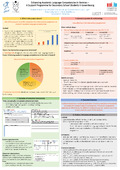
Results from the Luxembourg School Monitoring Programme in secondary school (https://dashboard.epstan.lu) illustrate that in the highest school track attended by only high-achieving students (comparable to the German Gymnasium), one in five students struggles with German reading comprehension. Furthermore, teachers reported that these struggles affect the students’ ability to express themselves in content-subjects taught in German (e.g. sciences).
To address these difficulties, researchers from the University of Luxembourg are collaborating with teachers to develop an intervention programme for 8th graders. The programme focuses on three central areas to enhance academic language competencies in German: (1) understanding and applying key aspects of German academic language, i.e. complex words and sentence structures, (2) promoting reading through age-appropriate encyclopaedia articles incorporating subject-specific content, and (3) developing written (academic) language competencies.
In the upcoming school year 2025-26, the programme will be scientifically evaluated at three time points through a mixed-methods design that encompasses standardized achievement tests assessing the central areas of the training, student questionnaires on motivation, and qualitative classroom observations. The aim is to evaluate the effectiveness of the intervention programme and to foster language-sensitive pedagogical practices in Luxembourg’s educational context.
BAUMANN, Sandra ; University of Luxembourg > Faculty of Humanities, Education and Social Sciences (FHSE) > LUCET
COLLING, Joanne ; University of Luxembourg > Faculty of Humanities, Education and Social Sciences (FHSE) > LUCET
WETH, Constanze ; University of Luxembourg > Faculty of Humanities, Education and Social Sciences (FHSE) > Department of Humanities (DHUM) > Multilingualism
UGEN, Sonja ; University of Luxembourg > Faculty of Humanities, Education and Social Sciences (FHSE) > LUCET
External co-authors :
no
Language :
English
Title :
Enhancing Academic Language Competencies in German - A Support Programme for Secondary School Students in Luxembourg
Publication date :
11 November 2025
Event name :
CIDER LERN conference
Event organizer :
The Leibniz Institute for Educational Trajectories (LIfBi), the Federal Institute for Population Research (BiB), the Leibniz Education Research Network (LERN), and the College for Interdisciplinary Educational Research (CIDER)