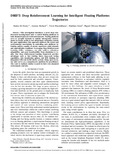
[en] This investigation introduces a novel deep reinforcement learning-based suite to control floating platforms in both simulated and real-world environments. Floating platforms serve as versatile test-beds to emulate microgravity environments on Earth, useful to test autonomous navigation systems for space applications. Our approach addresses the system and environmental uncertainties in controlling such platforms by
training policies capable of precise maneuvers amid dynamic and unpredictable conditions. Leveraging Deep Reinforcement Learning (DRL) techniques, our suite achieves robustness, adaptability, and good transferability from simulation to reality. Our deep reinforcement learning framework provides advantages such as fast training times, large-scale testing capabilities, rich visualization options, and ROS bindings for
integration with real-world robotic systems. Being open access, our suite serves as a comprehensive platform for practitioners who want to replicate similar research in their own simulated environments and labs.
Disciplines :
Computer science
Author, co-author :
EL HARIRY, Mhamed Matteo ; University of Luxembourg > Interdisciplinary Centre for Security, Reliability and Trust (SNT) > Space Robotics
RICHARD, Antoine ; University of Luxembourg > Interdisciplinary Centre for Security, Reliability and Trust (SNT) > Space Robotics
MURALIDHARAN, Vivek ; University of Luxembourg > Interdisciplinary Centre for Security, Reliability and Trust > Space Robotics > Team Miguel Angel OLIVARES MENDEZ
Geist, Matthieu; Matthieu Geist is With Cohere
Olivares-Mendez, Miguel; University of Luxembourg,Space Robotics (SpaceR) Research Group, SnT
External co-authors :
yes
Language :
English
Title :
DRIFT: Deep Reinforcement Learning for Intelligent Floating Platforms Trajectories
Publication date :
14 October 2024
Journal title :
IEEE International Conference on Intelligent Robots and Systems
ISSN :
2153-0858
Publisher :
Institute of Electrical and Electronics Engineers, New York, United States - New York