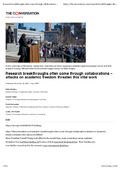
[en] Since President Donald Trump took office for the second time, many researchers across academic disciplines have had their funding cut because of their purported ideological bias. These funding cuts were further exacerbated by the extensive 2025 government shutdown. As a team of sociologists studying universities, higher education policy and administration, academic freedom and science production, we recognized these cuts as part of a recent global trend of weakened academic freedom. Since the mid-2000s, political attacks on higher education have increased in many countries. Consequently, academic freedom has declined in countries as different as India, Israel, Nicaragua and the United Kingdom, among others. For example, for years Hungarian Prime Minister Viktor Orbán accused the internationally respected Central European University of “liberal bias.” By 2019, he had effectively forced the university and its faculty into exile in Vienna, Austria. Since Argentinian President Javier Milei came to power in 2023, he has made repeated claims that academics are corrupt elites. He used this narrative to restrict universities’ autonomy and funding of their research programs. Today, most research is done collaboratively. But research finds that when individual scholars have less academic freedom and universities’ autonomy declines, global research collaborations are also threatened. The prevalence and complexity of those collaborations that optimize human and material resources has grown, with substantial impact on scientific productivity — what we call the global “collaboration dividend.” Collaborations foster solutions to complex problems, from vaccine development to renewable energy. Diminishing academic freedom erodes these collaboration dividends, which then reduces the quantity and quality of scientific discovery worldwide.
Research center :
Department of Social Sciences
Disciplines :
Sociology & social sciences Education & instruction
Author, co-author :
Chykina, Volha; University of Richmond
BAKER, David ; University of Luxembourg ; Penn State
Fernandez, Frank; University of Wisconsin-Madison
POWELL, Justin J. W. ; University of Luxembourg > Faculty of Humanities, Education and Social Sciences (FHSE) > Department of Social Sciences (DSOC) > Education and Society
Language :
English
Title :
Research breakthroughs often come through collaborations − attacks on academic freedom threaten this vital work