Abstract :
[en] Reading is one of the most important human skills and has been studied for years with different techniques. EEG frequency tagging with electroencephalography (EEG) recordings proved efficient to measure the neural basis of visual word recognition. Here we investigate the emergence of novel neural representations for written words in 32 adults (21 females; age mean=21.78; range=17-32 years old) who were tested with EEG before and after learning 32 rare French words according to two different methods. Half of the words were provided with orthographic and phonological information only, while the other half were also provided with explicit semantic information.
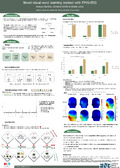
Participants were tested twice at one-week interval. During the first session, cognitive and language abilities were assessed, and a lexical decision task was performed. In the second session, they were capped with a 64 Biosemi system (EEG) for two EEG recordings (pre and post-learning), and a post-test lexical decision task was performed. Novel words were taught by blocs of 8, through different short learning tasks (matching, typing, etc…), and were counterbalanced so that they were either learned with orthography + phonology only (OP hereafter) or orthography + phonology + semantic (OPS hereafter). We used fast periodic visual stimulation (FPVS) coupled with EEG to measure selective neural responses to words. Base stimuli (pseudowords) were displayed at 10Hz during 1 min, and periodic deviant stimuli (words) occured every fifth stimulus (at 10Hz/5 thus 2Hz). Responses to deviant stimuli at 2Hz indicate that words have been automatically discriminated from pseudowords. Here we contrasted 4 sequence types displaying words (learned words OP, learned words OPS, unknown words, and known words) among respectively matched pseudowords. Every condition was repeated 4 times for a total of 16 sequences of 60 seconds.
EEG results show a significant learning effect (p<0.001), with larger word-selective responses over the left occipital-temporal cortex at post-test with both methods, while no pre/post difference was seen for control conditions (known and unknown words). Contrary to our hypothesis, larger amplitudes were found with the OP method than with the OPS method (p=0.036). These results reveal that discrimination of learned word among pseudowords was stronger when learnt with the orthographic method. Moreover, behavioral lexical decision data reveal that the new lexical trace of the learned words induced significant increases in reaction times both for novel words’ lexical neighbors and for 1-letter close pseudowords, suggesting competition effects arising with new lexicalizations. Those effects were stronger for OP words, as in EEG responses. This might indicate that the semantic method, implemented here by simultaneous image and word presentation during learning, drags the participant’s attention away from the orthographic form. This suggestion is supported by the fact that successful OPSs learning took longer than OP learning . Our findings open new perspectives to track novel word learning using EEG
Name of the research project :
U-AGR-7143 - C21/SC/16241557/READINGBRAIN (01/09/2022 - 31/08/2025) - LOCHY Aliette