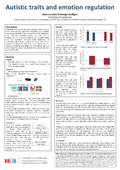
[en] Introduction: Individuals with Autism Spectrum Disorder (ASD) seem to have lower emotion regulation competence than typically developing individuals; they use more frequently suppression than reappraisal (Samson, Huber, & Gross, 2012). Additionally, low levels of resting heart rate variability (HRV) have been associated with poor social functioning and emotional rigidity (Butler, Wilhelm, & Gross, 2006), which characterize individuals with ASD. Therefore, it is hypothesized that typically developing individuals with more autistic traits use more frequently suppression instead of reappraisal and have lower resting HRV.
Methodology: 66 students (age: M=21.73, SD=2.49) participated in the study. Firstly, participants resting HRV was measured for 5 minutes. Afterwards, participants watched 5 videos of one minute long each (Gross & Levenson, 1995). Two videos were used to elicit disgust and three were neutral. After each video, participants completed a questionnaire about the emotions felt during the video (Ekman, Friesen, & Ancoli, 1980; adapted by Gross & Levenson, 1993). Finally, participants completed the Autism-Spectrum Quotient (AQ; Baron-Cohen et al., 2001), and the Emotion Regulation Questionnaire (ERQ; Gross & John, 2003).
Results: Participants who used more frequently suppression had more autistic traits (M=20.13, SD=4.73) than those who used more frequently reappraisal (M=15.06, SD=4.50; t(64)=3.80, p<.001). Furthermore, the more autistic traits participants had, the more they rated their emotions during the disgust-eliciting videos as pleasant (r(57)=.295, p<.05), and the more they reported feeling positive emotions (r(63)=.262, p<.05). However, no correlation was found regarding negative emotions. Concerning resting HRV participants with more autistic traits had higher HRV (r(47)=.29, p<.05).
Conclusions: Similarly to individuals with ASD, typically developing individuals with more autistic traits used more frequently suppression, demonstrating less emotion regulation competence. The reported higher rates of pleasantness during the disgust-eliciting videos and the overall experience of more positive emotions can be interpreted as a lack of cognitive empathy (Baron-Cohen & Wheelwright, 2004). The unexpected resting HRV result might be explained by differences in the pattern of physiological responding (Zahn, Rumsey, & Kammen, 1987).
Disciplines :
Psychologie cognitive & théorique
Auteur, co-auteur :
PINTO COSTA, Andreia ; University of Luxembourg > Faculty of Language and Literature, Humanities, Arts and Education (FLSHASE) > Integrative Research Unit: Social and Individual Development (INSIDE)
STEFFGEN, Georges ; University of Luxembourg > Faculty of Language and Literature, Humanities, Arts and Education (FLSHASE) > Integrative Research Unit: Social and Individual Development (INSIDE)