Article (Scientific journals)
Watch out electrons!: positron binding redefines chemical bonding in Be2.
Porras-Roldan, Rafael; CHARRY MARTINEZ, Jorge Alfonso; Moncada, Felix et al.
2025In Chemical Science, 16 (47), p. 22322 - 22332
Peer Reviewed verified by ORBi
 

Files


Full Text
d5sc05711f.pdf
Author postprint (2.34 MB) Creative Commons License - Attribution, Non-Commercial
Download

All documents in ORBilu are protected by a user license.

Send to


Details


Keywords :
Bonding interactions; Chemical bondings; Diverse applications; Electronic bonding; Electronic component; Localisation; New mechanisms; Positron density; Potential energy curves; Quantum Monte Carlo simulations; Chemistry (all)
Abstract :
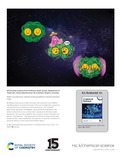
[en] Positrons, the antiparticles of electrons, serve as unique probes for fundamental interactions and are crucial in diverse applications. We present a new mechanism in chemical bonding: the formation of a positron-driven bond that fundamentally alters electronic bonding interactions. Investigating the Be2 dimer with Quantum Monte Carlo (QMC) simulations, we construct the potential energy curve of e+:Be2. Our analysis reveals a significant energetic stabilization of the Be-Be bond upon positron attachment, a result that challenges conventional understanding. We show this stabilization arises from a novel, two-stage mechanism: at longer distances, a positron bond forms via internuclear positron accumulation, similar to that in positron-anion systems. However, as the atoms approach equilibrium, the positron density undergoes a unique redistribution, moving out of the internuclear region to accumulate in the outer molecular vicinity. This distinct positron localization, combined with an otherwise repulsive electronic component, leads to overall system stabilization as the electron density dynamically follows the positron. This work expands our understanding of chemical bonding by strongly suggesting how an antiparticle can profoundly influence molecular stability.
Disciplines :
Chemistry
Author, co-author :
Porras-Roldan, Rafael ;  Department of Chemistry, Universidad Nacional de Colombia Av. Cra 30 45-03 Bogotá Colombia
CHARRY MARTINEZ, Jorge Alfonso  ;  University of Luxembourg ; Luxembourg Researchers Hub asbl 223 Rue de Luxembourg L-4222 Esch-sur-Alzette Luxembourg
Moncada, Felix ;  Department of Physics, AlbaNova University Center, Stockholm University 106 91 Stockholm Sweden
Flores-Moreno, Roberto ;  Departamento de Química, Universidad de Guadalajara Blvd. Marcelino García Barragán 1421, Col Olímpica Guadalajara Jal. C.P. 44430 Mexico
do N Varella, Márcio T ;  Instituto de Física, Universidade de São Paulo Rua do Matão 1731 05508-090 São Paulo Brazil areyesv@unal.edu.co
Reyes, Andrés ;  Department of Chemistry, Universidad Nacional de Colombia Av. Cra 30 45-03 Bogotá Colombia
External co-authors :
yes
Language :
English
Title :
Watch out electrons!: positron binding redefines chemical bonding in Be2.
Publication date :
03 December 2025
Journal title :
Chemical Science
ISSN :
2041-6520
eISSN :
2041-6539
Publisher :
Royal Society of Chemistry, England
Volume :
16
Issue :
47
Pages :
22322 - 22332
Peer reviewed :
Peer Reviewed verified by ORBi
Funders :
Conselho Nacional de Desenvolvimento Científico e Tecnológico
Universidad Nacional de Colombia
Funding text :
The QMC calculations presented in this paper were carried out using the HPC facilities of the University of Luxembourg84 (see https://hpc.uni.lu). The authors acknowledge Dr Matteo Barborini (matteo.barborini@uni.lu) for the support on QMeCha code, the implementation of the energy decomposition, discussions, and for providing the resources to perform the QMC calculations. MTNV acknowledges support from CNPq (Grant no.306285/2022-3). AR acknowledges support from Universidad Nacional de Colombia (HERMES 63579).
Available on ORBilu :
since 03 April 2026

Statistics


Number of views
16 (0 by Unilu)
Number of downloads
2 (0 by Unilu)

Scopus citations®
 
1
Scopus citations®
without self-citations
0

OpenCitations
 
0
OpenAlex citations
 
1
WoS citations
 
1

Bibliography


Similar publications


Contact ORBilu