Keywords :
High Dynamic Range; Radar; Unlimited Sensing; Analog to digital converters; Coherent demodulation; Computational system; High dynamic range; Hilbert transform; Measurements of; Over sampling; Radar signals; Stringent requirement; Unlimited sensing; Electrical and Electronic Engineering; Applied Mathematics; Signal Processing; Computer Science Applications
Abstract :
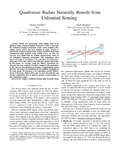
[en] Before any processing, radar signals need to be digitized using Analog-to-Digital Converters (ADCs). Recently, the Unlimited Sensing Framework (USF), where modulo-ADCs replace classic ADCs, has been studied in radar systems to alleviate the stringent requirements on the acquisition chain when encountering high dynamic range (HDR) scenes. In USF, the recovery of a signal from its modulo measurements relies on the embedded redundant information. This redundancy often appears through oversampling or the collections of modulo measurements of the same signal using different modulo thresholds. In this paper, we leverage, using the Hilbert Transform, the structure between channels of radars equipped with quadrature or IQ coherent demodulation to design a computational system that does not require oversampling nor the multiple acquisition of the same signal. We introduce a new algorithm, namely Hilbert-Pencil of Function (Hilbert-PoF), and we show theoretically and through simulations that it achieves perfect reconstructions in this challenging setting.
Funding text :
TF thanks Ahmed Murtada for the discussions and comments. TF s work is supported by FNR CORE SURF Project, ref C23/IS/18158802/SURF. The work of AB is supported by the UK Research and Innovation council s FLF Program Sensing Beyond Barriers via Non-Linearities (MRC Fellowship award no. MR/Y003926/1).
Scopus citations®
without self-citations
0