Baesch, 2025_Towards Acknowledging Dignity through Research Participation-Negotiating Vulnerability across Dis:Abilities and Institutional Barriers.pdf
Research Participation; Institutional Barriers; vulnerable groups; Complex Disabilities (CD)
Abstract :
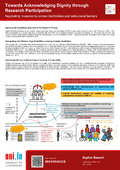
[en] Martha Nussbaums frames the key question concerning human dignity and capabilities as “What is each person able to do and to be?” (Nussbaum, 2011, p. 18). This conceptualisation of dignity underlying the Capability Approach (CA), can be applied to research processes and designs, too. CA can be used as a tool (see Robeyns, 2005) to guide decisionmaking in designing research projects on a very fundamental level – starting with research participation: Who is able to participate in what kind of research and in what kind of way? Although their right to have their views heard and listend to and to be involved in decisions a[ecting their lives (UN-CRC, 1989), childrens voices and perspectives are still often neglected in research. This holds particularly true for Disabled children and youth (Young & Clerke, 2024) and is aggravating even more in the context of Complex Disabilities (CD) (de Haas et al., 2022; Grace et al., 2024). Persons with CD – often referred to under the label of Profound Intellectual and Multiple Disabilities (PIMD) as well – have historically been construed and constructed as the epitome of a ‘vulnerable poplulation’ (Kittay, 2005; Vehmas & Mietola, 2021). Researchers often struggle to find ways to facilitate participation in research for a group of people whose lived experience diverges drastically from implicit and explicit norms (Maes et al., 2021; Skarsaune, 2023) and who challenges notions of administrative bodies of what constitutes a capable research participant (see Mietola et al., 2017). Drawing on Nussbaum and the CA to question who is able to be (considered) a research participant and who is excluded from the generation of knowledge identifies structural institutional barriers. Based on experiences from a qualitative research project exploring experiences of students with Additional Health Care Needs wanting to include children with Complex Disabilities as highly relevant stakeholders, this poster is outlining institutional barriers to participation of groups percieved as highly vulnerable. Identified barriers to participation of Children with CD are 1) mismatches between accessible research methods and requirements of approval-granting bodies of higher education institutions, 2) the unfamiliarity with ideosyncracies of researching with persons with CD, and 3) implicit reservations against the viability of including perspectives of persons with CD.
Disciplines :
Social & behavioral sciences, psychology: Multidisciplinary, general & others
Author, co-author :
BAESCH, Sophia ; University of Luxembourg > Faculty of Humanities, Education and Social Sciences (FHSE) > Department of Education and Social Work (DESW) > Teaching and Learning
External co-authors :
yes
Language :
English
Title :
Towards Acknowledging Dignity through Research Participation: Negotiating Vulnerability across Dis/Abilities and Institutional Barriers