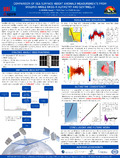
[en] Satellite altimetry has been employed since the Skylab mission in 1973, and subsequent satellite launches have aimed to gather altimetric data. However, conventional satellite altimetry suffers from limitations in both temporal and spatial resolution. To address these limitations, alternative techniques such as Global Navigation Satellite System Reflectometry (GNSS-R) have emerged, which utilizes signals of opportunity from GNSS to determine sea surface height. This study compares measurements from the Sentinel-3 satellite mission with carrier phase altimetric retrievals using Spire Global’s Low Earth Orbit satellite constellation under grazing angle geometries. These grazing angle GNSS-R signals, known as GG-R, exhibit lower accuracy than traditional satellite altimetry, but ongoing efforts are underway to enhance GG-R accuracy to the centimeter level. As part of this process, data validation, such as the one conducted in this study, plays a crucial role.
Disciplines :
Earth sciences & physical geography Space science, astronomy & astrophysics Physical, chemical, mathematical & earth Sciences: Multidisciplinary, general & others Engineering, computing & technology: Multidisciplinary, general & others
Author, co-author :
Buendía, Raquel Navarro
TABIBI, Sajad ; University of Luxembourg > Faculty of Science, Technology and Medicine (FSTM) > Department of Engineering (DoE)
Talpe, Matthieu
External co-authors :
yes
Language :
English
Title :
Comparision of Sea Surface Height Anomaly measurements from Grazing Angle GNSS-R Altimetry and Sentinel-3
Publication date :
May 2023
Event name :
IEEE GNSS+R 2023 – Specialist Meeting on Reflectometry using GNSS and other Signals of Opportunity
Event place :
Boulder, Colorado, United States
Event date :
May 24 – 26, 2023
By request :
Yes
Audience :
International
Main work title :
IEEE GNSS+R 2023
Publisher :
IEEE GNSS+R 2023
Peer reviewed :
Peer reviewed
Focus Area :
Computational Sciences
Development Goals :
13. Climate action
Commentary :
Place: Boulder, Colorado, USA Publisher: IEEE GNSS+R 2023