Cell Biology; Cell-based Assays; Molecular Biology; Neuroscience (all); Biochemistry, Genetics and Molecular Biology (all); Immunology and Microbiology (all)
Résumé :
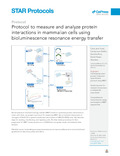
[en] Bioluminescence resonance energy transfer (BRET) allows to quantitate protein interactions in intact cells. Here, we present a protocol for measuring BRET due to transient interactions of oncogenic K-RasG12V in plasma membrane nanoclusters of HEK293-EBNA cells. We describe steps for seeding, transfecting, and replating cells. We then detail procedures for their preparation for BRET measurements on a CLARIOstar microplate reader and detailed data analysis. For complete details on the use and execution of this protocol, please refer to Steffen et al.1.
Disciplines :
Biochimie, biophysique & biologie moléculaire
Auteur, co-auteur :
DUVAL, Carla ; University of Luxembourg > Faculty of Science, Technology and Medicine (FSTM) > Department of Life Sciences and Medicine (DLSM)
STEFFEN, Candy ; University of Luxembourg > Faculty of Science, Technology and Medicine > Department of Life Sciences and Medicine > Team Daniel ABANKWA
PAVIC, Karolina ; University of Luxembourg > Faculty of Science, Technology and Medicine (FSTM) > Department of Life Sciences and Medicine (DLSM)
ABANKWA, Daniel ; University of Luxembourg > Faculty of Science, Technology and Medicine (FSTM) > Department of Life Sciences and Medicine (DLSM)
Co-auteurs externes :
no
Langue du document :
Anglais
Titre :
Protocol to measure and analyze protein interactions in mammalian cells using bioluminescence resonance energy transfer.
This work was supported by grants from the National Research Fund Luxembourg (FNR) INTER/UKRI/19/14174764-RAS-NANOME and INTER/NWO/19/14061736 - HRAS-PPi to D.K.A. and AFR/17927850/Duval C./KRuptor to C.J.D. We are grateful to Dr. Ganesh babu Manoharan for implementing the BRET technology in the Abankwa lab. The graphical abstract was created using BioRender.com .
Steffen, C.L., Manoharan, G.B., Pavic, K., Yeste-Vázquez, A., Knuuttila, M., Arora, N., Zhou, Y., Härmä, H., Gaigneaux, A., Grossmann, T.N., Abankwa, D.K., Identification of an H-Ras nanocluster disrupting peptide. Commun. Biol., 7, 2024, 837, 10.1038/s42003-024-06523-9.
Bacart, J., Corbel, C., Jockers, R., Bach, S., Couturier, C., The BRET technology and its application to screening assays. Biotechnol. J. 3 (2008), 311–324, 10.1002/biot.200700222.
den Hamer, A., Dierickx, P., Arts, R., de Vries, J.S.P.M., Brunsveld, L., Merkx, M., Bright Bioluminescent BRET Sensor Proteins for Measuring Intracellular Caspase Activity. ACS Sens. 2 (2017), 729–734, 10.1021/acssensors.7b00239.
Dacres, H., Michie, M., Wang, J., Pfleger, K.D.G., Trowell, S.C., Effect of enhanced Renilla luciferase and fluorescent protein variants on the Forster distance of Bioluminescence resonance energy transfer (BRET). Biochem. Biophys. Res. Commun. 425 (2012), 625–629, 10.1016/j.bbrc.2012.07.133.
Abankwa, D., Gorfe, A.A., Mechanisms of Ras Membrane Organization and Signaling: Ras Rocks Again. Biomolecules, 10, 2020, 1522, 10.3390/biom10111522.
Hamdan, F.F., Percherancier, Y., Breton, B., Bouvier, M., Monitoring protein-protein interactions in living cells by bioluminescence resonance energy transfer (BRET). Curr. Protoc. Neurosci., Chapter 5, 2006, 10.1002/0471142301.ns0523s34 Unit 5.23.
Manoharan, G.B., Laurini, C., Bottone, S., Ben Fredj, N., Abankwa, D.K., K-Ras Binds Calmodulin-Related Centrin1 with Potential Implications for K-Ras Driven Cancer Cell Stemness. Cancers, 15, 2023, 3087, 10.3390/cancers15123087.
Okutachi, S., Manoharan, G.B., Kiriazis, A., Laurini, C., Catillon, M., McCormick, F., Yli-Kauhaluoma, J., Abankwa, D., A Covalent Calmodulin Inhibitor as a Tool to Study Cellular Mechanisms of K-Ras-Driven Stemness. Front. Cell Dev. Biol., 9, 2021, 665673, 10.3389/fcell.2021.665673.
Kaya, P., Schaffner-Reckinger, E., Manoharan, G.B., Vukic, V., Kiriazis, A., Ledda, M., Burgos Renedo, M., Pavic, K., Gaigneaux, A., Glaab, E., Abankwa, D.K., An Improved PDE6D Inhibitor Combines with Sildenafil To Inhibit KRAS Mutant Cancer Cell Growth. J. Med. Chem. 67 (2024), 8569–8584, 10.1021/acs.jmedchem.3c02129.
Lavoie, H., Thevakumaran, N., Gavory, G., Li, J.J., Padeganeh, A., Guiral, S., Duchaine, J., Mao, D.Y.L., Bouvier, M., Sicheri, F., Therrien, M., Inhibitors that stabilize a closed RAF kinase domain conformation induce dimerization. Nat. Chem. Biol. 9 (2013), 428–436, 10.1038/nchembio.1257.
Terrell, E.M., Durrant, D.E., Ritt, D.A., Sealover, N.E., Sheffels, E., Spencer-Smith, R., Esposito, D., Zhou, Y., Hancock, J.F., Kortum, R.L., Morrison, D.K., Distinct Binding Preferences between Ras and Raf Family Members and the Impact on Oncogenic Ras Signaling. Mol. Cell 76 (2019), 872–884.e5, 10.1016/j.molcel.2019.09.004.
Parkkola, H., Siddiqui, F.A., Oetken-Lindholm, C., Abankwa, D., FLIM-FRET Analysis of Ras Nanoclustering and Membrane-Anchorage. Methods Mol. Biol. 2262 (2021), 233–250, 10.1007/978-1-0716-1190-6_13.
Siddiqui, F.A., Alam, C., Rosenqvist, P., Ora, M., Sabt, A., Manoharan, G.B., Bindu, L., Okutachi, S., Catillon, M., Taylor, T., et al. PDE6D Inhibitors with a New Design Principle Selectively Block K-Ras Activity. ACS Omega 5 (2020), 832–842, 10.1021/acsomega.9b03639.