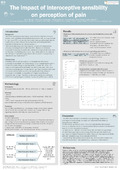
[en] Interoceptive sensibility is the self-perceived dispositional tendency to be internally self-focused and interoceptively cognizant. One would expect that persons with high interoceptive sensibility would be more consistent in their subjective ratings to pain stimulation, i.e., the same intensity would be rated similarly across different time points of the session. The present study investigated the relationship between interoceptive sensibility and perception of acute pain, realized by transcutaneous electrical stimulation to the inner forearm, compromising both the subjective pain ratings and the cardiovascular response to the painful stimulation in young healthy adults. To determine the interoceptive sensibility the MAIA-2 was used. In two session design participants received short, individualized pain stimuli in the non-painful to moderate pain range, which they rated regarding subjective intensity and unpleasantness on visual analog scales. The task was repeated three times in one session.
Preliminary results suggest a positive relationship between different subscales of the MAIA-2 and the intensity and unpleasantness ratings of painful and non-painful stimulations. Over the three repetitions of stimulation, a differentiated picture forms with respect to possible sensitization or habituation of the participants.
These findings suggest that there is an impact of interoceptive sensibility on the perception of pain.
Using the MAIA-2 to determine the interoceptive sensibility is an economical approach, since previous studies worked with the heartbeat detection task or other experimental paradigms.
Incorporating interoceptive sensitivity could be helpful for future interventions and possible treatments in pain patients.
Disciplines :
Treatment & clinical psychology Social & behavioral sciences, psychology: Multidisciplinary, general & others Animal psychology, ethology & psychobiology
Author, co-author :
Michels, Mara; University of Luxembourg, Esch-sur-Alzette, Luxembourg > Department of Behavioural and Cognitive Sciences, Institute for Health and Behaviour,
VAN DER MEULEN, Marian ; University of Luxembourg > Faculty of Humanities, Education and Social Sciences (FHSE) > Department of Behavioural and Cognitive Sciences (DBCS)
SCHULZ, André ; University of Luxembourg > Faculty of Humanities, Education and Social Sciences (FHSE) > Department of Behavioural and Cognitive Sciences (DBCS)
Vögele, Claus ; University of Luxembourg > Faculty of Humanities, Education and Social Sciences (FHSE) > Department of Behavioural and Cognitive Sciences (DBCS)
DIEROLF, Angelika ; University of Luxembourg > Faculty of Humanities, Education and Social Sciences (FHSE) > Department of Behavioural and Cognitive Sciences (DBCS)
External co-authors :
yes
Language :
English
Title :
The impact of interoceptive sensibility on the perception of pain
Alternative titles :
[en] The impact of interoceptive sensibility on the perception of pain
Publication date :
09 June 2023
Number of pages :
A0 Poster
Event name :
48. Jahrestagung Psychologie & Gehirn
Event organizer :
Eberhard Karls Universität Tübingen, Jan Born und das Organisationsteam um Lisa Bastian, Julia Fechner und Max Harkotte
Event place :
Tübingen, Germany
Event date :
08-06-2023 to 10-06-2023
Audience :
International
Peer review/Selection committee :
Peer reviewed
FnR Project :
FNR14672835 - Cognitive Modulation Of Pain In Aging – Impact Of Stress And Executive Functions – A Psychophysiological Approach, 2020 (01/09/2021-29/02/2024) - Angelika Dierolf
Name of the research project :
Cognitive Modulation Of Pain In Aging – Impact Of Stress And Executive Functions – A Psychophysiological Approach