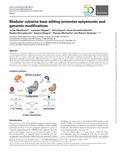
[en] Prokaryotic and eukaryotic adaptive immunity differ considerably. Yet, their fundamental mechanisms of gene editing via Cas9 and activation-induced deaminase (AID), respectively, can be conveniently complimentary. Cas9 is an RNA targeted dual nuclease expressed in several bacterial species. AID is a cytosine deaminase expressed in germinal centre B cells to mediate genomic antibody diversification. AID can also mediate epigenomic reprogramming via active DNA demethylation. It is known that sequence motifs, nucleic acid structures, and associated co-factors affect AID activity. But despite repeated attempts, deciphering AID's intrinsic catalytic activities and harnessing its targeted recruitment to DNA is still intractable. Even recent cytosine base editors are unable to fully recapitulate AID's genomic and epigenomic editing properties. Here, we describe the first instance of a modular AID-based editor that recapitulates the full spectrum of genomic and epigenomic editing activity. Our 'Swiss army knife' toolbox will help better understand AID biology per se as well as improve targeted genomic and epigenomic editing.
Disciplines :
Hematology Immunology & infectious disease Human health sciences: Multidisciplinary, general & others Biotechnology Genetics & genetic processes Life sciences: Multidisciplinary, general & others
Author, co-author :
Weischedel, Julian; Institute of Experimental Immunology, University of Zurich, Zurich 8057, Switzerland.
Higgins, Laurence; Living Systems Institute, University of Exeter, Exeter EX4 4QD, UK.
Rogers, Sally; Living Systems Institute, University of Exeter, Exeter EX4 4QD, UK.
Gramalla-Schmitz, Anna; Institute of Experimental Immunology, University of Zurich, Zurich 8057, Switzerland.
Wyrzykowska, Paulina; Institute of Experimental Immunology, University of Zurich, Zurich 8057, Switzerland.
Borgoni, Simone; Institute of Experimental Immunology, University of Zurich, Zurich 8057, Switzerland.
MacCarthy, Thomas; Department of Applied Mathematics & Statistics, Stony Brook University, NY 11794-3600, USA.
CHAHWAN, Richard ; University of Luxembourg ; Institute of Experimental Immunology, University of Zurich, Zurich 8057, Switzerland.
External co-authors :
yes
Language :
English
Title :
Modular cytosine base editing promotes epigenomic and genomic modifications.
Publication date :
25 January 2024
Journal title :
Nucleic Acids Research
ISSN :
0305-1048
eISSN :
1362-4962
Publisher :
Oxford University Press, Gb
Volume :
52
Issue :
2
Pages :
e8
Peer reviewed :
Peer Reviewed verified by ORBi
Funding number :
310030_212553/SNF/; 22B140/Novartis Foundation/; 41309/Vontobel Stiftung/; F-41309-01-01/UZH/; UZH-URPP/; Translational Cancer Research/; Swiss Excellence Scholarship/; Functional Genomics Center Zurich/; ETH Zurich/
Jinek,M., East,A., Cheng,A., Lin,S., Ma,E. and Doudna,J. (2013) RNA-programmed genome editing in human cells. eLife, 2, e00471.
Ran,F.A., Hsu,P.D., Wright,J., Agarwala,V., Scott,D.A. and Zhang,F. (2013) Genome engineering using the CRISPR-Cas9 system. Nat. Protoc., 8, 2281–2308.
Jinek,M., Chylinski,K., Fonfara,I., Hauer,M., Doudna,J.A. and Charpentier,E. (2012) A programmable dual-RNA-guided DNA endonuclease in adaptive bacterial immunity. Science , 337, 816–821.
Kosicki,M., Tomberg,K. and Bradley,A. (2018) Repair of double-strand breaks induced by CRISPR–Cas9 leads to large deletions and complex rearrangements. Nat. Biotechnol., 36, 765–771.
Cervantes-Gracia,K., Gramalla-Schmitz,A., Weischedel,J. and Chahwan,R. (2021) APOBECs orchestrate genomic and epigenomic editing across health and disease. Trends Genet., 37, 1028–1043.
Muramatsu,M., Kinoshita,K., Fagarasan,S., Yamada,S., Shinkai,Y. and Honjo,T. (2000) Class switch recombination and hypermutation require activation-induced cytidine deaminase (AID), a potential RNA editing enzyme. Cell, 102, 553–563.
Pham,P., Bransteitter,R., Petruska,J. and Goodman,M.F. (2003) Processive AID-catalysed cytosine deamination on single-stranded DNA simulates somatic hypermutation. Nature, 424, 103–107.
Petersen-Mahrt,S.K., Harris,R.S. and Neuberger,M.S. (2002) AID mutates E. coli suggesting a DNA deamination mechanism for antibody diversification. Nature, 418, 99–104.
Yu,K., Huang,F.T. and Lieber,M.R. (2004) DNA substrate length and surrounding sequence affect the activation-induced deaminase activity at cytidine. J. Biol. Chem., 279, 6496–6500.
Wei,L., Chahwan,R., Wang,S., Wang,X., Pham,P.T., Goodman,M.F., Bergman,A., Scharff,M.D. and MacCarthy,T. (2015) Overlapping hotspots in CDRs are critical sites for V region diversification. Proc. Natl. Acad. Sci. U.S.A., 112, E728–E737.
Jolly,C.J., Wagner,S.D., Rada,C., Klix,N., Milstein,C. and Neuberger,M.S. (1996) The targeting of somatic hypermutation. Semin. Immunol., 8, 159–168.
Peled,J.U., Kuang,F.L., Iglesias-Ussel,M.D., Roa,S., Kalis,S.L., Goodman,M.F. and Scharff,M.D. (2008) The biochemistry of somatic hypermutation. Annu. Rev. Immunol., 26, 481–511.
Rai,K., Huggins,I.J., James,S.R., Karpf,A.R., Jones,D.A. and Cairns,B.R. (2008) DNA demethylation in Zebrafish involves the coupling of a deaminase, a glycosylase, and Gadd45. Cell, 135, 1201–1212.
Zhu,J.K. (2009) Active DNA demethylation mediated by DNA glycosylases. Annu. Rev. Genet., 43, 143–166.
Wijesinghe,P. and Bhagwat,A.S. (2012) Efficient deamination of 5-methylcytosines in DNA by human APOBEC3A, but not by AID or APOBEC3G. Nucleic Acids Res., 40, 9206–9217.
Budzko,L., Jackowiak,P., Kamel,K., Sarzynska,J., Bujnicki,J.M. and Figlerowicz,M. (2017) Mutations in human AID differentially affect its ability to deaminate cytidine and 5-methylcytidine in ssDNA substrates in vitro. Sci. Rep., 7, 3873.
Kunimoto,H., McKenney,A.S., Meydan,C., Shank,K., Nazir,A., Rapaport,F., Durham,B., Garrett-Bakelman,F.E., Pronier,E., Shih,A.H., et al. (2017) Aid is a key regulator of myeloid/erythroid differentiation and DNA methylation in hematopoietic stem/progenitor cells. Blood, 129, 1779–1790.
Dominguez,P.M., Teater,M., Chambwe,N., Kormaksson,M., Redmond,D., Ishii,J., Vuong,B., Chaudhuri,J., Melnick,A., Vasanthakumar,A., et al. (2015) DNA methylation dynamics of germinal center B cells are mediated by AID. Cell Rep., 12, 2086–2098.
Komor,A.C., Kim,Y.B., Packer,M.S., Zuris,J.A. and Liu,D.R. (2016) Programmable editing of a target base in genomic DNA without double-stranded DNA cleavage. Nature, 533, 420–424.
Nishida,K., Arazoe,T., Yachie,N., Banno,S., Kakimoto,M., Tabata,M., Mochizuki,M., Miyabe,A., Araki,M., Hara,K.Y., et al. (2016) Targeted nucleotide editing using hybrid prokaryotic and vertebrate adaptive immune systems. Science, 353, 1248–1256.
Hess,G.T., Frésard,L., Han,K., Lee,C.H., Li,A., Cimprich,K.A., Montgomery,S.B. and Bassik,M.C. (2016) Directed evolution using dCas9-targeted somatic hypermutation in mammalian cells. Nat. Methods, 13, 1036–1042.
Liu,L.D., Huang,M., Dai,P., Liu,T., Fan,S., Cheng,X., Zhao,Y., Yeap,L.S. and Meng,F.L. (2018) Intrinsic nucleotide preference of diversifying base editors guides antibody ex vivo affinity maturation. Cell Rep., 25, 884–892.
Ren,B., Yan,F., Kuang,Y., Li,N., Zhang,D., Zhou,X., Lin,H. and Zhou,H. (2018) Improved base editor for efficiently inducing genetic variations in rice with CRISPR/Cas9-guided hyperactive hAID mutant. Mol. Plant, 11, 623–626.
Xiong,X., Li,Z., Liang,J., Liu,K., Li,C. and Li,J.F. (2022) A cytosine base editor toolkit with varying activity windows and target scopes for versatile gene manipulation in plants. Nucleic Acids Res., 50, 3565–3580.
Ranzau,B.L. and Komor,A.C. (2019) Genome, epigenome, and transcriptome editing via chemical modification of nucleobases in living cells. Biochemistry, 58, 330–335.
Naito,Y., Hino,K., Bono,H. and Ui-Tei,K. (2015) CRISPRdirect: software for designing CRISPR/Cas guide RNA with reduced off-target sites. Bioinformatics, 31, 1120–1123.
Agudelo,D., Duringer,A., Bozoyan,L., Huard,C.C., Carter,S., Loehr,J., Synodinou,D., Drouin,M., Salsman,J., Dellaire,G., et al. (2017) Marker-free coselection for CRISPR-driven genome editing in human cells. Nat. Methods, 14, 615–620.
Liu,X.S., Wu,H., Ji,X., Stelzer,Y., Wu,X., Czauderna,S., Shu,J., Dadon,D., Young,R.A. and Jaenisch,R. (2016) Editing DNA methylation in the mammalian genome. Cell, 167, 233–247.
Mali,P., Yang,L., Esvelt,K.M., Aach,J., Guell,M., DiCarlo,J.E., Norville,J.E. and Church,G.M. (2013) RNA-guided human genome engineering via Cas9. Science, 339, 823–826.
Clement,K., Rees,H., Canver,M.C., Gehrke,J.M., Farouni,R., Hsu,J.Y., Cole,M.A., Liu,D.R., Joung,J.K., Bauer,D.E., et al. (2019) CRISPResso2 provides accurate and rapid genome editing sequence analysis. Nat. Biotechnol., 37, 224–226.
Yu,G., Wu,Y., Duan,Z., Tang,C., Xing,H., Scharff,M.D. and MacCarthy,T. (2021) A Bayesian model based computational analysis of the relationship between bisulfite accessible single-stranded DNA in chromatin and somatic hypermutation of immunoglobulin genes. PLoS Comput. Biol., 17, e1009323.
McIntosh,M.T., Koganti,S., Boatwright,J.L., Li,X., Spadaro,S.V., Brantly,A.C., Ayers,J.B., Perez,R.D., Burton,E.M., Burgula,S., et al. (2020) STAT3 imparts BRCAness by impairing homologous recombination repair in Epstein-Barr virus-transformed B lymphocytes. PLoS Pathog., 16, e1008849.
Wang,L., Xue,W., Yan,L., Li,X., Wei,J., Chen,M., Wu,J., Yang,B., Yang,L. and Chen,J. (2017) Enhanced base editing by co-expression of free uracil DNA glycosylase inhibitor. Cell Res., 27, 1289–1292.
Saha,T., Sundaravinayagam,D. and Di Virgilio,M. (2021) Charting a DNA repair roadmap for immunoglobulin class switch recombination. Trends Biochem. Sci, 46, 184–199.
Wang,S., Lee,K., Gray,S., Zhang,Y., Tang,C., Morrish,R.B., Tosti,E., Van Oers,J., Amin,M.R., Cohen,P.E., et al. (2022) Role of EXO1 nuclease activity in genome maintenance, the immune response and tumor suppression in Exo1D173Amice. Nucleic Acids Res., 50, 8093–8106.
Brunk,B.P., Goldhamer,D.J. and Emerson,C.P. (1996) Regulated demethylation of the myoD distal enhancer during skeletal myogenesis. Dev. Biol., 177, 490–503.
Mamrut,S., Harony,H., Sood,R., Shahar-Gold,H., Gainer,H., Shi,Y.J., Barki-Harrington,L. and Wagner,S. (2013) DNA methylation of specific CpG sites in the promoter region regulates the transcription of the mouse oxytocin receptor. PLoS One, 8, e56869.
Martin,A. and Scharff,M.D. (2002) Somatic hypermutation of the AID transgene in B and non-B cells. Proc. Natl. Acad. Sci. U.S.A., 99, 12304–12308.
Bowers,P.M., Horlick,R.A., Neben,T.Y., Toobian,R.M., Tomlinson,G.L., Dalton,J.L., Jones,H.A., Chen,A., Altobell,L., Zhang,X., et al. (2011) Coupling mammalian cell surface display with somatic hypermutation for the discovery and maturation of human antibodies. Proc. Natl. Acad. Sci. U.S.A., 108, 20455–20460.
Wang,X., Fan,M., Kalis,S., Wei,L. and Scharff,M.D. (2014) A source of the single-stranded DNA substrate for activation-induced deaminase during somatic hypermutation. Nat. Commun., 5, 4137.
Pavri,R., Gazumyan,A., Jankovic,M., Di Virgilio,M., Klein,I., Ansarah-Sobrinho,C., Resch,W., Yamane,A., San-Martin,B.R., Barreto,V., et al. (2010) Activation-induced cytidine deaminase targets DNA at sites of RNA polymerase II stalling by interaction with Spt5. Cell, 143, 122–133.
Hamperl,S. and Cimprich,K.A. (2016) Conflict resolution in the genome: how transcription and replication make it work. Cell, 167, 1455–1467.
Beerli,R.R., Segal,D.J., Dreier,B. and Barbas,C.F. (1998) Toward controlling gene expression at will: specific regulation of the erbB-2/HER-2 promoter by using polydactyl zinc finger proteins constructed from modular building blocks. Proc. Natl. Acad. Sci. U.S.A., 95, 14628–14633.
Maeder,M.L., Linder,S.J., Cascio,V.M., Fu,Y., Ho,Q.H. and Joung,J.K. (2013) CRISPR RNA-guided activation of endogenous human genes. Nat. Methods, 10, 977–979.
Sakhtemani,R., Perera,M.L.W., Hübschmann,D., Siebert,R., Lawrence,M.S. and Bhagwat,A.S. (2022) Human activation-induced deaminase lacks strong replicative strand bias or preference for cytosines in hairpin loops. Nucleic Acids Res., 50, 5145–5157.
Komor,A.C., Zhao,K.T., Packer,M.S., Gaudelli,N.M., Waterbury,A.L., Koblan,L.W., Kim,Y.B., Badran,A.H. and Liu,D.R. (2017) Improved base excision repair inhibition and bacteriophage mu Gam protein yields C:g-to-T:a base editors with higher efficiency and product purity. Sci. Adv., 3, eaao4774.
Liu,Z., Shan,H., Chen,S., Chen,M., Zhang,Q., Lai,L. and Li,Z. (2019) Improved base editor for efficient editing in GC contexts in rabbits with an optimized AID-Cas9 fusion. FASEB J., 33, 9210–9219.
Wang,M., Yang,Z., Rada,C. and Neuberger,M.S. (2009) AID upmutants isolated using a high-throughput screen highlight the immunity/cancer balance limiting DNA deaminase activity. Nat. Struct. Mol. Biol., 16, 769–776.
Zahn,A., Eranki,A.K., Patenaude,A.M., Methot,S.P., Fifield,H., Cortizas,E.M., Foster,P., Imai,K., Durandy,A., Larijani,M., et al. (2014) Activation induced deaminase C-terminal domain links DNA breaks to end protection and repair during class switch recombination. Proc. Natl. Acad. Sci. U.S.A., 111, E988–E997.
Dong,X., Yang,C., Ma,Z., Chen,M., Zhang,X. and Bi,C. (2022) Enhancing glycosylase base-editor activity by fusion to transactivation modules. Cell Rep., 40, 111090.
Frieder,D., Larijani,M., Collins,C., Shulman,M. and Martin,A. (2009) The concerted action of Msh2 and UNG stimulates somatic hypermutation at A T base pairs. Mol. Cell. Biol., 29, 5148–5157.
Porto,E.M., Komor,A.C., Slaymaker,I.M. and Yeo,G.W. (2020) Base editing: advances and therapeutic opportunities. Nat. Rev. Drug Discov., 19, 839–859.
Stavnezer,J., Guikema,J.E.J. and Schrader,C.E. (2008) Mechanism and regulation of class switch recombination. Annu. Rev. Immunol., 26, 261–292.
Feng,Y., Seija,N., D:i Noia,J.M. and Martin,A. (2020) AID in antibody diversification: there and back again. Trends Immunol., 41, 586–600.
Wiedemann,E.M., Peycheva,M. and Pavri,R. (2016) DNA replication origins in immunoglobulin switch regions regulate class switch recombination in an R-loop-dependent manner. Cell Rep., 17, 2927–2942.
Qiao,Q., Wang,L., Meng,F.L., Hwang,J.K., Alt,F.W. and Wu,H. (2017) AID recognizes structured DNA for class switch recombination. Mol. Cell, 67, 361–373.
Hamperl,S. and Cimprich,K.A. (2014) The contribution of co-transcriptional RNA: DNA hybrid structures to DNA damage and genome instability. DNA Repair (Amst.), 19, 84–94.
Ling,A.K., So,C.C., Le,M.X., Chen,A.Y., Hung,L. and Martin,A. (2018) Double-stranded DNA break polarity skews repair pathway choice during intrachromosomal and interchromosomal recombination. Proc. Natl. Acad. Sci. U.S.A., 115, 2800–2805.
So,C.C. and Martin,A. (2019) DSB structure impacts DNA recombination leading to class switching and chromosomal translocations in human B cells. PLoS Genet., 15, e1008101.
Tang,C., Bagnara,D., Chiorazzi,N., Scharff,M.D. and MacCarthy,T. (2020) AID overlapping and polη hotspots are key features of evolutionary variation within the Human antibody heavy chain (IGHV) genes. Front. Immunol., 11, 788.
Wilson,P.C., De Bouteiller,O., Liu,Y.J., Potter,K., Banchereau,J., Capra,J.D. and Pascual,V. (1998) Somatic hypermutation introduces insertions and deletions into immunoglobulin V genes. J. Exp. Med., 187, 59–70.
Bowers,P.M., Verdino,P., Wang,Z., Da Silva Correia,J., Chhoa,M., Macondray,G., Do,M., Neben,T.Y., Horlick,R.A., Stanfield,R.L., et al. (2014) Nucleotide insertions and deletions complement point mutations to massively expand the diversity created by somatic hypermutation of antibodies. J. Biol. Chem., 289, 33557–33567.
Hon,G.C., Song,C.X., Du,T., Jin,F., Selvaraj,S., Lee,A.Y., Yen,C.A., Ye,Z., Mao,S.Q., Wang,B.A., et al. (2014) 5mC oxidation by Tet2 modulates enhancer activity and timing of transcriptome reprogramming during differentiation. Mol. Cell, 56, 286–297.
Wang,X., Li,J., Wang,Y., Yang,B., Wei,J., Wu,J., Wang,R., Huang,X., Chen,J. and Yang,L. (2018) Efficient base editing in methylated regions with a human apobec3a-cas9 fusion. Nat. Biotechnol., 36, 946.