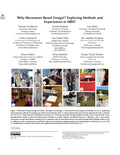
[en] The rise of movement-based design (MBD) is fueled by the integration of computer technology into the movement of the everyday. Departing from traditional interface design, MBD prioritizes natural interaction, SportsHCI, and health promotion through physical activity. This paradigm shift has led to innovations in experimental applications and interaction techniques, including exergames, expressivity in interactions and soma-design. Various guidelines and frameworks have been proposed for specific purposes, from sports to virtual reality. This workshop explores participants' experiences and perspectives on MBD, delving into MBD workshop design and reflect on MBD methods and the current move towards MBD methodologies.
Disciplines :
Computer science
Author, co-author :
Van Rheden, Vincent ; University of Salzburg, Salzburg, Austria
Reidsma, Dennis ; University of Twente, Enschede, Netherlands
Elbæk, Lars ; University of Southern Denmark, Odense, Denmark
LALLEMAND, Carine ; University of Luxembourg > Faculty of Humanities, Education and Social Sciences (FHSE) > Department of Behavioural and Cognitive Sciences (DBCS) > Cognitive Science and Assessment
Turmo Vidal, Laia ; KTH Royal Institute of Technology, Stockholm, Sweden
Matviienko, Andrii ; KTH Royal Institute of Technology, Stockholm, Sweden
Elvitigala, Don Samitha ; Exertion Games Lab, Monash University, Melbourne, Australia
Daiber, Florian ; German Research Center for Artifcial Intelligence (DFKI), Saarbrücken, Germany
Zambetta, Fabio ; RMIT University, Melbourne, Australia
Mueller, Florian ; Exertion Games Lab, Monash University, Melbourne, Australia
External co-authors :
yes
Language :
English
Title :
Why Movement-Based Design!? Exploring Methods and Experiences in MBD
Publication date :
July 2024
Event name :
Designing Interactive Systems Conference
Event place :
Copenhagen, Dnk
Event date :
01-07-2024 => 05-07-2024
Audience :
International
Main work title :
DIS 2024 - Proceedings of the 2024 ACM Designing Interactive Systems Conference
Australian Research Council EU Erasmus+ Leibnitz- Zentrum für Informatik Austrian Federal Ministry for Climate Action, Environment, Energy, Mobility, Innovation and Technology, the Federal Ministry for Digital and Economic Affairs, and the federal state of Salzburg under the research programme COMET - Competence Centers for Excellent Technologies Sweden?s Digital Futures Research Center Postdoctoral Fellowship
Funding text :
The authors gratefully acknowledge the financial support from the Austrian Federal Ministry for Climate Action, Environment, Energy, Mobility, Innovation, and Technology, the Federal Ministry for Digital and Economic Affairs, and the federal state of Salzburg under the research programme COMET - Competence Centers for Excellent Technologies - in the project DiMo-NEXT Digital Motion in Sports, Fitness and Well-being (Project number: FO999904898) and the EU Erasmus+ project Method Cards for Movement-based Interaction Design (MeCaMInD), grant number 2020-1-DK01-KA203-075164. Laia Turmo Vidal is supported by Sweden's Digital Futures Research Center Postdoctoral Fellowship (nr 81501). Florian 'Floyd' Mueller thanks the Australian Research Council, especially DP190102068, DP200102612, and LP210200656. This work has benefited from the Dagstuhl Seminar 23292 \"SportsHCI\" [36]. We thank the LeibnitzZentrum für Informatik for hosting us at Schlo\u00DF Dagstuhl.
Sarah Fdili Alaoui, Baptiste Caramiaux, Marcos Serrano, and Frédéric Bevilacqua. 2012. Movement qualities as interaction modality. In Proceedings of the Designing Interactive Systems Conference (Newcastle Upon Tyne, United Kingdom) (DIS '12). Association for Computing Machinery, New York, NY, USA, 761-769. https://doi.org/10.1145/2317956.2318071
Mattias Arvola and Henrik Artman. 2007. Enactments in interaction design: How designers make sketches behave. Artifact: Journal of Design Practice 1, 2 (2007), 106-119.
Jon Back, Laia Turmo Vidal, Annika Waern, Susan Paget, and Eva-Lotta Sallnäs Pysander. 2018. Playing Close to Home: Interaction and Emerging Play in Outdoor Play Installations. In Proceedings of the 2018 CHI Conference on Human Factors in Computing Systems (Montreal, Canada) (CHI '18). Association for Computing Machinery, New York, NY, USA, 1-11. https://doi.org/10.1145/3173574.3173730
Genevieve Bell, Mark Blythe, and Phoebe Sengers. 2005. Making by making strange: Defamiliarization and the design of domestic technologies. ACM Trans. Comput.-Hum. Interact. 12, 2 (jun 2005), 149-173. https://doi.org/10.1145/1067860.1067862
Severin Bernhart, Harald Rieser, Vincent van Rheden, and Rainer Matischek. 2022. Using CAPSENSE in a Wearable Textile Chest Belt for Respiration Sensing and Interaction Possibility. In Proceedings of the 2nd international "Salzburg Conference for Smart Materials.
Colin Burns, Eric Dishman, William Verplank, and Bud Lassiter. 1994. Actors, hairdos & videotape-informance design. In Conference Companion on Human Factors in Computing Systems (Boston, Massachusetts, USA) (CHI '94). Association for Computing Machinery, New York, NY, USA, 119-120. https://doi.org/10.1145/259963.260102
Oguz Turan Buruk and Oguzhan Özcan. 2018. Extracting Design Guidelines for Wearables and Movement in Tabletop Role-Playing Games via a Research Through Design Process. In Proceedings of the 2018 CHI Conference on Human Factors in Computing Systems (Montreal, Canada) (CHI '18). Association for Computing Machinery, New York, NY, USA, 1-13. https://doi.org/10.1145/3173574.3174087
Florian Daiber, Michael Jones, Frederik Wiehr, Keith Cheverst, Felix Kosmalla, and Jonna Häkkilä. 2017. UbiMount: 2nd workshop on ubiquitous computing in the mountains. In Proceedings of the 2017 ACM International Joint Conference on Pervasive and Ubiquitous Computing and Proceedings of the 2017 ACM International Symposium on Wearable Computers (Maui, Hawaii) (UbiComp '17). Association for Computing Machinery, New York, NY, USA, 1022-1026. https://doi.org/10.1145/3123024.3124462
Florian Daiber, Felix Kosmalla, Christian Murlowski, and Antonio Krüger. 2018. Slackliner: Using Whole-body Gestures for Interactive Slackline Training. In Proceedings of the 2018 ACM Symposium on Spatial User Interaction (Berlin, Germany) (SUI '18). Association for Computing Machinery, New York, NY, USA, 174. https://doi.org/10.1145/3267782.3274691
Ida Damen, Ingmar Nieuweboer, Hans Brombacher, Pieter van Wesemael, Steven Vos, and Carine Lallemand. 2021. The Ofce Jungle: Exploring Unusual Ways of Working through Bodily Experimentations. In Proceedings of the 2021 ACM Designing Interactive Systems Conference (Virtual Event, USA) (DIS '21). Association for Computing Machinery, New York, NY, USA, 466-477. https://doi.org/10.1145/3461778.3462062
J. P. Djajadiningrat, W. W. Gaver, and J. W. Fres. 2000. Interaction relabelling and extreme characters: methods for exploring aesthetic interactions. In Proceedings of the 3rd Conference on Designing Interactive Systems: Processes, Practices, Methods, and Techniques (New York City, New York, USA) (DIS '00). Association for Computing Machinery, New York, NY, USA, 66-71. https://doi.org/10.1145/347642.347664
Lars Elbæk, Rasmus Vestergaard Andersen, Robby W. Van Delden, José María Font Fernández, René Engelhardt Hansen, Perttu Hämäläinen, Mats Johnsson, Lærke Schjødt Rasmussen, Søren Lekbo, Solip Park, Dees Postma, Dennis Reidsma, Elena Márquez Segura, Ana Tajadura-Jimenez, Laia Turmo Vidal, Jose Manuel Vega Cebrian, Annika Waern, and Maximus Kaos. 2023. Method Cards for Movement-based Design. https://doi.org/10.21996/08h8-mx91 ISBN: 978-87-94345-70-5.
Lars Elbæk, Rasmus Vestergaard Andersen, Lærke Schjødt Rasmussen, and Maximus Kaos. 2023. Exploring Movement-Modifer Facilitation in Movement-based Sports, Health, and Game Design. In European Conference on Games Based Learning, Vol. 17. 162-170.
Don Samitha Elvitigala, Yunfan Wang, Yongquan Hu, and Aaron J Quigley. 2023. RadarFoot: Fine-grain Ground Surface Context Awareness for Smart Shoes. In Proceedings of the 36th Annual ACM Symposium on User Interface Software and Technology (San Francisco, USA) (UIST '23). Association for Computing Machinery, New York, NY, USA, Article 87, 13 pages. https://doi.org/10.1145/3586183.3606738
Perttu Hämäläinen, Joe Marshall, Raine Kajastila, Richard Byrne, and Florian "Floyd" Mueller. 2015. Utilizing Gravity in Movement-Based Games and Play. In Proceedings of the 2015 Annual Symposium on Computer-Human Interaction in Play (London, United Kingdom) (CHI PLAY '15). Association for Computing Machinery, New York, NY, USA, 67-77. https://doi.org/10.1145/2793107.2793110
Eric Harbour, Vincent van Rheden, Hermann Schwameder, and Thomas Finkenzeller. 2023. Step-adaptive sound guidance enhances locomotor-respiratory coupling in novice female runners: A proof-of-concept study. Frontiers in Sports and Active Living 5 (2023), 1112663.
Martin Hedlund, Cristian Bogdan, Gerrit Meixner, and Andrii Matviienko. 2024. Rowing Beyond: Investigating Steering Methods for Rowing-based Locomotion in Virtual Environments. In Proceedings of the 2024 CHI Conference on Human Factors in Computing Systems (CHI '24). Association for Computing Machinery, New York, NY, USA. https://doi.org/10.1145/3613904.3642192
Martin Hedlund, Anders Lundström, Cristian Bogdan, and Andrii Matviienko. 2023. Jogging-in-Place: Exploring Body-Steering Methods for Jogging in Virtual Environments. In Proceedings of the 22nd International Conference on Mobile and Ubiquitous Multimedia (Vienna, Austria) (MUM '23). Association for Computing Machinery, New York, NY, USA, 377-385. https://doi.org/10.1145/3626705.3627778
Kristina Höök. 2018. Designing with the body: Somaesthetic interaction design. MIT Press.
Kristina Höök, Martin Jonsson, Anna Ståhl, Jakob Tholander, Toni Robertson, Patrizia Marti, Dag Svanaes, Marianne Graves Petersen, Jodi Forlizzi, Thecla Schiphorst, Katherine Isbister, Caroline Hummels, Sietske Klooster, Lian Loke, and George Poonkhin Khut. 2016. Move to be Moved. In Proceedings of the 2016 CHI Conference Extended Abstracts on Human Factors in Computing Systems (San Jose, California, USA) (CHI EA '16). Association for Computing Machinery, New York, NY, USA, 3301-3308. https://doi.org/10.1145/2851581.2856470
Kristina Höök, Martin P. Jonsson, Anna Stahl, and Johanna Mercurio. 2016. Somaesthetic Appreciation Design. In Proceedings of the 2016 CHI Conference on Human Factors in Computing Systems (San Jose, California, USA) (CHI '16). Association for Computing Machinery, New York, NY, USA, 3131-3142. https://doi.org/10.1145/2858036.2858583
Caroline Hummels, Kees CJ Overbeeke, and Sietske Klooster. 2007. Move to get moved: a search for methods, tools and knowledge to design for expressive and rich movement-based interaction. Personal and Ubiquitous Computing 11 (2007), 677-690.
Kristina Höök, Martin P. Jonsson, Anna Staahl, and Johanna Mercurio. 2016. Somaesthetic Appreciation Design. In Proceedings of the 2016 CHI Conference on Human Factors in Computing Systems (CHI '16). ACM, New York, NY, USA, 3131-3142. https://doi.org/10.1145/2858036.2858583
Mélodie Jacob, Ida Damen, and Carine Lallemand. 2023. Exploring the Embodied Experience of Walking Meetings through Bodystorming - Implications for Design. In Proceedings of the Seventeenth International Conference on Tangible, Embedded, and Embodied Interaction (Warsaw, Poland) (TEI '23). Association for Computing Machinery, New York, NY, USA, Article 24, 14 pages. https://doi.org/10.1145/3569009.3572795
Raine Kajastila, Leo Holsti, and Perttu Hämäläinen. 2016. The Augmented Climbing Wall: High-Exertion Proximity Interaction on aWall-Sized Interactive Surface. In Proceedings of the 2016 CHI Conference on Human Factors in Computing Systems (San Jose, California, USA) (CHI '16). Association for Computing Machinery, New York, NY, USA, 758-769. https://doi.org/10.1145/2858036.2858450
Felix Kosmalla, Christian Murlowski, Florian Daiber, and Antonio Krüger. 2018. Slackliner-An Interactive Slackline Training Assistant. In Proceedings of the 26th ACM International Conference on Multimedia (Seoul, Republic of Korea) (MM '18). Association for Computing Machinery, New York, NY, USA, 154-162. https://doi.org/10.1145/3240508.3240537
Felix Kosmalla, Christian Murlowski, Florian Daiber, Frederik Wiehr, and Antonio Krüger. 2017. Slackliner: an interactive assistant for slackline training. In Proceedings of the 2017 ACM International Joint Conference on Pervasive and Ubiquitous Computing and Proceedings of the 2017 ACM International Symposium on Wearable Computers (Maui, Hawaii) (UbiComp '17). Association for Computing Machinery, New York, NY, USA, 1056-1061. https://doi.org/10.1145/3123024.3124448
Lian Loke and Toni Robertson. 2013. Moving and making strange: An embodied approach to movement-based interaction design. ACM Trans. Comput.-Hum. Interact. 20, 1, Article 7 (apr 2013), 25 pages. https://doi.org/10.1145/2442106.2442113
Lian Loke and Thecla Schiphorst. 2018. The Somatic Turn in Human-computer Interaction. Interactions 25, 5 (Aug. 2018), 54-5863. https://doi.org/10.1145/3236675
Elena Márquez Segura, Katta Spiel, Karin Johansson, Jon Back, Phoebe O. Toups Dugas, Jessica Hammer, Annika Waern, Theresa Jean Tanenbaum, and Katherine Isbister. 2019. Larping (Live Action Role Playing) as an Embodied Design Research Method. In Companion Publication of the 2019 on Designing Interactive Systems Conference 2019 Companion (San Diego, CA, USA) (DIS '19 Companion). Association for Computing Machinery, New York, NY, USA, 389-392. https://doi.org/10.1145/3301019.3320002
Elena Márquez Segura, Laia Turmo Vidal, and Asreen Rostami. 2016. Bodystorming for movement-based interaction design. Human Technology 12 (2016).
Elena Márquez Segura, Laia Turmo Vidal, Asreen Rostami, and Annika Waern. 2016. Embodied Sketching. In Proceedings of the 2016 CHI Conference on Human Factors in Computing Systems (San Jose, California, USA) (CHI '16). Association for Computing Machinery, New York, NY, USA, 6014-6027. https://doi.org/10.1145/2858036.2858486
Florian Mueller, Martin R. Gibbs, Frank Vetere, and Darren Edge. 2014. Supporting the creative game design process with exertion cards. In Proceedings of the SIGCHI Conference on Human Factors in Computing Systems (Toronto, Ontario, Canada) (CHI '14). Association for Computing Machinery, New York, NY, USA, 2211-2220. https://doi.org/10.1145/2556288.2557272
Florian 'Floyd' Mueller, Stefan Agamanolis, Martin R. Gibbs, and Frank Vetere. 2008. Remote impact: shadowboxing over a distance. In CHI '08 Extended Abstracts on Human Factors in Computing Systems (Florence, Italy) (CHI EA '08). Association for Computing Machinery, New York, NY, USA, 2291-2296. https://doi.org/10.1145/1358628.1358672
Florian 'Floyd' Mueller, Darren Edge, Frank Vetere, Martin R. Gibbs, Stefan Agamanolis, Bert Bongers, and Jennifer G. Sheridan. 2011. Designing sports: a framework for exertion games. In Proceedings of the SIGCHI Conference on Human Factors in Computing Systems (Vancouver, Canada) (CHI '11). Association for Computing Machinery, New York, NY, USA, 2651-2660. https://doi.org/10.1145/1978942.1979330
Florian 'Floyd' Mueller, Carine Lallemand, Dennis Reidsma, Elise van den Hoven, and Maria F. Montoya. 2024. SportsHCI (Dagstuhl Seminar 23292). Dagstuhl Reports 13, 7 (2024), 108-151. https://doi.org/10.4230/DagRep.13.7.108
Florian Floyd Mueller, Joe Marshall, Rohit Ashok Khot, Stina Nylander, and Jakob Tholander. 2015. Understanding Sports-HCI by Going Jogging at CHI. In Proceedings of the 33rd Annual ACM Conference Extended Abstracts on Human Factors in Computing Systems (Seoul, Republic of Korea) (CHI EA '15). Association for Computing Machinery, New York, NY, USA, 869-872. https://doi.org/10.1145/2702613.2727688
Christian Murlowski, Florian Daiber, Felix Kosmalla, and Antonio Krüger. 2019. Slackliner 2.0: Real-time Training Assistance through Life-size Feedback. In Extended Abstracts of the 2019 CHI Conference on Human Factors in Computing Systems (Glasgow, UK) (CHI EA '19). Association for Computing Machinery, New York, NY, USA, 1-4. https://doi.org/10.1145/3290607.3313250
Stina Nylander, Jakob Tholander, Florian 'Floyd' Mueller, and Joseph Marshall. 2015. HCI and sports. Interactions 22, 2 (feb 2015), 30-31. https://doi.org/10.1145/2729712
Antti Oulasvirta, Esko Kurvinen, and Tomi Kankainen. 2003. Understanding contexts by being there: case studies in bodystorming. Personal and ubiquitous computing 7 (2003), 125-134.
Wei Peng, Julia C Crouse, and Jih-Hsuan Lin. 2013. Using active video games for physical activity promotion: a systematic review of the current state of research. Health education & behavior 40, 2 (2013), 171-192. https://doi.org/10.1177/1090198112444956
Dees BW Postma, Robby W van Delden, Jeroen H Koekoek, Wytse W Walinga, Ivo M van Hilvoorde, Bert Jan F van Beijnum, Fahim A Salim, Dennis Reidsma, et al. 2022. A Design Space of Sports Interaction Technology. Foundations and Trends® in Human-Computer Interaction 15, 2-3 (2022), 132-316.
Dennis Reidsma, Robby W. van Delden, Joris P. Weijdom, René Engelhardt Hansen, Søren Lekbo, Rasmus Vestergaard Andersen, Lærke Schjødt Rasmussen Rasmussen, and Lars Elbæk. 2022. Considerations for (Teaching) Facilitator Roles for Movement-Based Design. In Extended Abstracts of the 2022 Annual Symposium on Computer-Human Interaction in Play (Bremen, Germany) (CHI PLAY '22). Association for Computing Machinery, New York, NY, USA, 233-239. https://doi.org/10.1145/3505270.3558315
Juan Restrepo-Villamizar, Steven Vos, Evert Verhagen, and Carine Lallemand. 2021. Crafting On-Skin Interfaces: An Embodied Prototyping Journey. In Proceedings of the 2021 ACM Designing Interactive Systems Conference (Virtual Event, USA) (DIS '21). Association for Computing Machinery, New York, NY, USA, 1129-1142. https://doi.org/10.1145/3461778.3462055
Thecla Schiphorst. 2011. Self-evidence: applying somatic connoisseurship to experience design. In CHI '11 Extended Abstracts on Human Factors in Computing Systems (Vancouver, BC, Canada) (CHI EA '11). Association for Computing Machinery, New York, NY, USA, 145-160. https://doi.org/10.1145/1979742.1979640
Dennis Schleicher, Peter Jones, and Oksana Kachur. 2010. Bodystorming as embodied designing. Interactions 17, 6 (nov 2010), 47-51. https://doi.org/10.1145/1865245.1865256
Richard Shusterman. 1999. Somaesthetics: A disciplinary proposal. The journal of aesthetics and art criticism 57, 3 (1999), 299-313.
Richard Shusterman. 2008. Body consciousness: A philosophy of mindfulness and somaesthetics. Cambridge University Press.
Kristian T. Simsarian. 2003. Take it to the next stage: the roles of role playing in the design process. In CHI '03 Extended Abstracts on Human Factors in Computing Systems (Ft. Lauderdale, Florida, USA) (CHI EA '03). Association for Computing Machinery, New York, NY, USA, 1012-1013. https://doi.org/10.1145/765891.766123
Vasiliki Tsaknaki, Madeline Balaam, Anna Ståhl, Pedro Sanches, Charles Windlin, Pavel Karpashevich, and Kristina Höök. 2019. Teaching Soma Design. In Proceedings of the 2019 on Designing Interactive Systems Conference (San Diego, CA, USA) (DIS '19). Association for Computing Machinery, New York, NY, USA, 1237-1249. https://doi.org/10.1145/3322276.3322327
Laia Turmo Vidal, Elena Márquez Segura, and Annika Waern. 2018. Movement Correction in Instructed Fitness Training: Design Recommendations and Opportunities. In Proceedings of the 2018 Designing Interactive Systems Conference (Hong Kong, China) (DIS '18). Association for Computing Machinery, New York, NY, USA, 1041-1054. https://doi.org/10.1145/3196709.3196789
Laia Turmo Vidal, Elena Márquez Segura, Laia Turmo Vidal, and Elena Márquez Segura. 2018. Documenting the Elusive and Ephemeral in Embodied Design Ideation Activities. Multimodal Technologies and Interaction 2, 3 (June 2018), 35. https://doi.org/10.3390/mti2030035
Laia Turmo Vidal, Elena Márquez Segura, and Annika Waern. 2018. Sensory bodystorming for collocated physical training design. In Proceedings of the 10th Nordic Conference on Human-Computer Interaction (Oslo, Norway) (NordiCHI '18). Association for Computing Machinery, New York, NY, USA, 247-259. https://doi.org/10.1145/3240167.3240224
Vincent van Rheden, Thomas Grah, Alexander Meschtscherjakov, Rakesh Patibanda, Wanyu Liu, Florian Daiber, Elise van den Hoven, and Florian 'Floyd' Mueller. 2021. Out of Your Mind!? Embodied Interaction in Sports. In Extended Abstracts of the 2021 CHI Conference on Human Factors in Computing Systems (Yokohama, Japan) (CHI EA '21). Association for Computing Machinery, New York, NY, USA, Article 79, 5 pages. https://doi.org/10.1145/3411763.3441329
Vincent van Rheden, Eric Harbour, Thomas Finkenzeller, Lisa Anneke Burr, Alexander Meschtscherjakov, and Manfred Tscheligi. 2021. Run, beep, breathe: exploring the efects on adherence and user experience of 5 breathing instruction sounds while running. In Proceedings of the 16th International Audio Mostly Conference. 16-23.
Vincent van Rheden, Eric Harbour, Thomas Finkenzeller, and Alexander Meschtscherjakov. 2023. Breath Tools: Exploring the Efects on Adherence and User Experience of 4 Sounds Assisting Runners with Coupling Breath to Steps. In Extended Abstracts of the 2023 CHI Conference on Human Factors in Computing Systems (Hamburg, Germany) (CHI EA '23). Association for Computing Machinery, New York, NY, USA, Article 57, 7 pages. https://doi.org/10.1145/3544549.3585736
Vincent van Rheden, Eric Harbour, Thomas Finkenzeller, and Alexander Meschtscherjakov. 2024. Into the Rhythm: Evaluating Breathing Instruction Sound Experiences on the Run with Novice Female Runners. Multimodal Technologies and Interaction 8, 4 (2024), 25.
José Manuel Vega-Cebrián, Elena Márquez Segura, Laia Turmo Vidal, Omar Valdiviezo-Hernández, Annika Waern, Robby Van Delden, Joris Weijdom, Lars Elbæk, Rasmus Vestergaard Andersen, Søren Stigkær Lekbo, and Ana Tajadura-Jiménez. 2023. Design Resources in Movement-based Design Methods: a Practice-based Characterization. In Proceedings of the 2023 ACM Designing Interactive Systems Conference (DIS '23). Association for Computing Machinery, New York, NY, USA, 871-888. https://doi.org/10.1145/3563657.3596036
Joris Weijdom. 2022. Performative prototyping in collaborative mixed reality environments: an embodied design method for ideation and development in virtual reality. In Proceedings of the Sixteenth International Conference on Tangible, Embedded, and Embodied Interaction (Daejeon, Republic of Korea) (TEI '22). Association for Computing Machinery, New York, NY, USA, Article 10, 13 pages. https://doi.org/10.1145/3490149.3501316
Daniel Wigdor and Dennis Wixon. 2011. Brave NUI world: designing natural user interfaces for touch and gesture. Elsevier.
Danielle Wilde, Anna Vallgårda, and Oscar Tomico. 2017. Embodied Design Ideation Methods: Analysing the Power of Estrangement. In Proceedings of the 2017 CHI Conference on Human Factors in Computing Systems (Denver, Colorado, USA) (CHI '17). Association for Computing Machinery, New York, NY, USA, 5158-5170. https://doi.org/10.1145/3025453.3025873