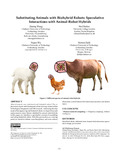
[en] What if animals were substituted with biohybrid robots? The replacement of pets with bioinspired robots has long existed within technological imaginaries and HRI research. Addressing developments of bioengineering and biohybrid robots, we depart from such replacement to study futures inhabited by animal-robot hybrids. In this paper, we introduce a speculative concept of assembling and eating biohybrid robots. With this provocation as a starting point, we intend to initiate cross-disciplinary and cross-cultural discussions around human-food interaction practices and related topics.
Disciplines :
Sciences sociales & comportementales, psychologie: Multidisciplinaire, généralités & autres Ingénierie, informatique & technologie: Multidisciplinaire, généralités & autres
Auteur, co-auteur :
WANG, Ziming ; University of Luxembourg > Faculty of Humanities, Education and Social Sciences (FHSE) ; Chalmers University of Technology
Barker, Ned; University College London - UCL
Wu, Yiqian; Chalmers University of Technology
Fjeld, Morten; Chalmers University of Technology ; University of Bergen
Co-auteurs externes :
yes
Langue du document :
Anglais
Titre :
Substituting Animals with Biohybrid Robots: Speculative Interactions with Animal-Robot Hybrids
Date de publication/diffusion :
juillet 2023
Nom de la manifestation :
DIS '23: Designing Interactive Systems Conference
Organisateur de la manifestation :
Carnegie Mellon University
Lieu de la manifestation :
Pittsburgh, Etats-Unis
Date de la manifestation :
2023-07-10 to 2023-07-14
Manifestation à portée :
International
Titre de l'ouvrage principal :
DIS '23 Companion: Companion Publication of the 2023 ACM Designing Interactive Systems Conference
Maison d'édition :
Association for Computing Machinery, New York, Etats-Unis
Ferran Altarriba Bertran, Samvid Jhaveri, Rosa Lutz, Katherine Isbister, and Danielle Wilde. 2019. Making Sense of Human-Food Interaction. In Proceedings of the 2019 CHI Conference on Human Factors in Computing Systems (Glasgow, Scotland Uk) (CHI '19). ACM, New York, NY, USA, 1-13. https://doi. org/10. 1145/3290605. 3300908
Carlos Alvaro. 2022. A virtue-ethical approach to cultured meat. Nature Food 3 (2022), 788-790. https://doi. org/10. 1038/s43016-022-00601-z
James Auger. 2012. Why robot?: Speculative design, the domestication of technology and the considered future. Ph. D. Dissertation.
Tom L. Beauchamp and James F. Childress. 2019. Principles of Biomedical Ethics. Oxford University Press.
Sara Berger and Francesca Rossi. 2023. AI and Neurotechnology: Learning from AI Ethics to Address an Expanded Ethics Landscape. Commun. ACM 66, 3 (feb 2023), 58-68. https://doi. org/10. 1145/3529088
Robert M. Calif and Susan T. Mayne. 2022. FDA Spurs Innovation for Human Food from Animal Cell Culture Technology. Retrieved January 19, 2023 from https://www. fda. gov/news-events/press-announcements/fda-spursinnovation-human-food-animal-cell-culture-technology
Mark Coeckelbergh. 2011. Humans, Animals, and Robots: A Phenomenological Approach to Human-Robot Relations. Int J of Soc Robotics 3 (2011), 197-204. https://doi. org/10. 1007/s12369-010-0075-6
Kate Darling. 2021. The New Breed: What Our History with Animals Reveals about Our Future with Robots. Henry Holt and Company. https://books. google. se/books?id=oTrGDwAAQBAJ
Jialin Deng, Patrick Olivier, Josh Andres, Kirsten Ellis, Ryan Wee, and Florian Floyd Mueller. 2022. Logic Bonbon: Exploring Food as Computational Artifact. In Proceedings of the 2022 CHI Conference on Human Factors in Computing Systems (New Orleans, LA, USA) (CHI '22). ACM, New York, NY, USA, Article 47, 21 pages. https://doi. org/10. 1145/3491102. 3501926
Luciano Floridi. 2013. The Ethics of Information. Oxford University Press.
Luciano Floridi and Josh Cowls. 2019. A Unifed Framework of Five Principles for AI in Society. Harvard Data Science Review 1, 1 (jul 1 2019).
Tom Gayler, Corina Sas, and Vaiva Kalnikaite. 2020. Material Food Probe: Per-sonalized 3D Printed Flavors for Emotional Communication in Intimate Rela-tionships. In Proceedings of the 2020 ACM Designing Interactive Systems Confer-ence (Eindhoven, Netherlands) (DIS '20). ACM, New York, NY, USA, 965-978. https://doi. org/10. 1145/3357236. 3395533
Linda G. Grifth and Gail Naughton. 2002. Tissue engineering-current challenges and expanding opportunities. Science 295, 5557 (2002), 1009-1014. https://doi. org/10. 1126/science. 1069210
Andrea Grimes and Richard Harper. 2008. Celebratory Technology: New Di-rections for Food Research in HCI. In Proceedings of the SIGCHI Conference on Human Factors in Computing Systems (Florence, Italy) (CHI '08). ACM, New York, NY, USA, 467-476. https://doi. org/10. 1145/1357054. 1357130
José Halloy. 2018. Sustainability of living machines. In Living machines: A handbook of research in biomimetics and biohybrid systems. Oxford University Press. https://doi. org/10. 1093/oso/9780199674923. 003. 0065
Annika Hupfeld and Tom Rodden. 2012. Laying the Table for HCI: Uncovering Ecologies of Domestic Food Consumption. In Proceedings of the SIGCHI Conference on Human Factors in Computing Systems (Austin, Texas, USA) (CHI '12). ACM, New York, NY, USA, 119-128. https://doi. org/10. 1145/2207676. 2207694
Carey Jewitt, Ned Barker, and Jürgen Steimle. 2022. Interactive skin through a social-sensory speculative lens. The Senses and Society (2022), 1-21. https://doi. org/10. 1080/17458927. 2022. 2145840
Ranu Jung. 2011. Biohybrid Systems: Nerves, Interfaces, and Machines. John Wiley & Sons, Ltd. https://doi. org/10. 1002/9783527639366
Viirj Kan, Emma Vargo, Noa Machover, Hiroshi Ishii, Serena Pan, Weixuan Chen, and Yasuaki Kakehi. 2017. Organic primitives. Proceedings of the 2017 CHI Conference on Human Factors in Computing Systems (2017). https://doi. org/10. 1145/3025453. 3025952
Kasun Karunanayaka, Adrian David Cheok, Nur Amira Samshir, Nurafqah Johari, Surina Hariri, Nur Ellyza Abd Rahman, and Nur Ain Mustafaand Prem Anton. 2016. Electric, thermal, and magnetic based digital interfaces for Next Generation Food Experiences. Integrative Food, Nutrition and Metabolism 3, 1 (2016). https://doi. org/10. 15761/ifnm. 1000137
Matej Karásek, Florian T. Muijres, Christophe De Wagter, Bart D. W. Remes, and Guido C. H. E. de Croon. 2018. A tailless aerial robotic fapper reveals that fies use torque coupling in rapid banked turns. Science 361, 6407 (2018), 1089-1094. https://doi. org/10. 1126/science. aat0350
Rohit Ashok Khot and Florian Mueller. 2019. Human-Food Interaction. Now Publishers. https://books. google. se/books?id=meE8xQEACAAJ
David Mcfarland and Tom Bösser. 2003. Intelligent Behavior in Animals and Robots. The MIT Press. https://doi. org/10. 7551/mitpress/3830. 001. 0001
Yuya Morimoto, Hiroaki Onoe, and Shoji Takeuchi. 2018. Biohybrid robot pow-ered by an antagonistic pair of skeletal muscle tissues. Science Robotics 3, 18 (2018), eaat4440. https://doi. org/10. 1126/scirobotics. aat4440
Martin Murer, Ilhan Aslan, and Manfred Tscheligi. 2013. LOLLio: Exploring Taste as Playful Modality. In Proceedings of the 7th International Conference on Tangible, Embedded and Embodied Interaction (Barcelona, Spain) (TEI '13). ACM, New York, NY, USA, 299-302. https://doi. org/10. 1145/2460625. 2460675
Chrystopher L. Nehaniv and Kerstin Dautenhahn. 2007. Imitation and So-cial Learning in Robots, Humans and Animals: Behavioural, Social and Com-municative Dimensions. Cambridge University Press. https://doi. org/10. 1017/CBO9780511489808
Marianna Obrist, Rob Comber, Sriram Subramanian, Betina Piqueras-Fiszman, Carlos Velasco, and Charles Spence. 2014. Temporal, Afective, and Embodied Characteristics of Taste Experiences: A Framework for Design. In Proceedings of the SIGCHI Conference on Human Factors in Computing Systems (Toronto, Ontario, Canada) (CHI '14). ACM, New York, NY, USA, 2853-2862. https://doi. org/10. 1145/2556288. 2557007
Marianna Obrist, Alexandre N. Tuch, and Kasper Hornbaek. 2014. Opportunities for Odor: Experiences with Smell and Implications for Technology (CHI '14). ACM, New York, NY, USA, 2843-2852. https://doi. org/10. 1145/2556288. 2557008
Marianna Obrist, Carlos Velasco, Chi Thanh Vi, Nimesha Ranasinghe, Ali Is-rar, Adrian D. Cheok, Charles Spence, and Ponnampalam Gopalakrishnakone. 2016. Touch, Taste, & Smell User Interfaces: The Future of Multisensory HCI. In Proceedings of the 2016 CHI Conference Extended Abstracts on Human Fac-tors in Computing Systems (CHI EA '16). ACM, New York, NY, USA, 3285-3292. https://doi. org/10. 1145/2851581. 2856462
Edward N. O'Neill, Zachary A. Cosenza, Keith Baar, and David E. Block. 2021. Considerations for the development of cost-efective cell culture media for culti-vated meat production. Comprehensive Reviews in Food Science and Food Safety 20, 1 (2021), 686-709. https://doi. org/10. 1111/1541-4337. 12678
Mark J Post, Shulamit Levenberg, David L Kaplan, and colleagues. 2020. Scientifc, sustainability and regulatory challenges of cultured meat. Nat Food 1, 8 (2020), 403-415. https://doi. org/10. 1038/s43016-020-0112-z
Tony J. Prescott, Nathan Lepora, and Paul F. M. J Verschure. 2018. Living machines: A handbook of research in biomimetics and biohybrid systems. Oxford University Press. https://doi. org/10. 1093/oso/9780199674923. 001. 0001
Tony J. Prescott, Nathan Lepora, and Paul F. M. J. Vershure. 2014. A future of living machines?: International trends and prospects in biomimetic and biohy-brid systems. In Bioinspiration, Biomimetics, and Bioreplication 2014, Akhlesh Lakhtakia (Ed.), Vol. 9055. International Society for Optics and Photonics, SPIE, 905502. https://doi. org/10. 1117/12. 2046305
Virgin Radio. 2022. Extinct Dodo bird could be brought back to life after a DNA breakthrough from scientists. Retrieved January 19, 2023 from https://virginradio. co. uk/lifestyle/54182/extinct-dodo-bird-could-be-brought-back-to-life-after-a-dna-breakthrough-from-scientists
Nimesha Ranasinghe, Kasun Karunanayaka, Adrian David Cheok, Owen Noel Newton Fernando, Hideaki Nii, and Ponnampalam Gopalakrishnakone. 2011. Digital Taste and Smell Communication. In Proceedings of the 6th Interna-tional Conference on Body Area Networks (Beijing, China) (BodyNets '11). ICST (Institute for Computer Sciences, Social-Informatics and Telecommunications Engineering), Brussels, BEL, 78-84.
María Ignacia Rodríguez Escobar, Erasmo Cadena, Trang T. Nhu, Margot Cooreman-Algoed, Stefaan De Smet, and Jo Dewulf. 2021. Analysis of the Cultured Meat Production System in Function of Its Environmental Footprint: Current Status, Gaps and Recommendations. Foods 10, 12 (2021). https://doi. org/10. 3390/foods10122941
Speculativeedu. 2019. Cameron Tonkinwise: Creating visions of futures must involve thinking through the complexities. Retrieved January 19, 2023 from https://speculativeedu. eu/interview-cameron-tonkinwise/
Charles Spence and Betina Piqueras-Fiszman. 2014. The perfect meal: The multi-sensory science of food and dining. John Wiley & Sons, Ltd.
Neil Stephens, Lucy Di Silvio, Illtud Dunsford, Marianne Ellis, Abigail Glencross, and Alexandra Sexton. 2018. Bringing cultured meat to market: Technical, socio-political, and regulatory challenges in cellular agriculture. Trends in Food Science & Technology 78 (2018), 155-166. https://doi. org/10. 1016/j. Tifs. 2018. 04. 010
Nora S. Vaage. 2020. Living Machines: Metaphors We Live By. Nanoethics 14, 57-70 (2020). https://doi. org/10. 1007/s11569-019-00355-2
J. van der Valk, D. Brunner, K. De Smet, Å. Fex Svenningsen, P. Honegger, L. E. Knudsen, T. Lindl, J. Noraberg, A. Price, M. L. Scarino, and G. Gstraunthaler. 2010. Optimization of chemically defned cell culture media-Replacing fetal bovine serum in mammalian in vitro methods. Toxicology in Vitro 24, 4 (2010), 1053-1063. https://doi. org/10. 1016/j. Tiv. 2010. 03. 016
Wen Wang, Lining Yao, Teng Zhang, Chin-Yi Cheng, Daniel Levine, and Hiroshi Ishii. 2017. Transformative Appetite: Shape-Changing Food Transforms from 2D to 3D by Water Interaction through Cooking. In Proceedings of the 2017 CHI Conference on Human Factors in Computing Systems (Denver, Colorado, USA) (CHI '17). ACM, New York, NY, USA, 6123-6132. https://doi. org/10. 1145/3025453. 3026019
Ziming Wang, Ziyi Hu, Yemao Man, and Morten Fjeld. 2022. A Collaborative System of Flying and Ground Robots with Universal Physical Coupling Interface (PCI), and the Potential Interactive Applications (CHI EA '22). Association for Computing Machinery, New York, NY, USA, Article 460, 7 pages. https://doi. org/10. 1145/3491101. 3519766
ZimingWang, Ziyi Hu, Björn Rohles, Sara Ljungblad, Vincent Koenig, and Morten Fjeld. 2023. The Efects of Natural Sounds and Proxemic Distances on the Per-ception of a Noisy Domestic Flying Robot. ACM Transactions on Human-Robot Interaction (jan 2023). https://doi. org/10. 1145/3579859 Just Accepted.
Victoria A Webster-Wood, Maria Guix, Nicole W Xu, Bahareh Behkam, Hirotaka Sato, Deblina Sarkar, Samuel Sanchez, Masahiro Shimizu, and Kevin Kit Parker. 2022. Biohybrid robots: recent progress, challenges, and perspectives. Bioin-spiration & Biomimetics 18, 1 (nov 2022), 015001. https://doi. org/10. 1088/1748-3190/ac9c3b
Juyang Weng, James McClelland, Alex Pentland, Olaf Sporns, Ida Stockman, Mriganka Sur, and Esther Thelen. 2001. Autonomous Mental Development by Robots and Animals. Science 291, 5504 (2001), 599-600. https://doi. org/10. 1126/science. 291. 5504. 599
Amit Zoran and Dror Cohen. 2018. Digital Konditorei: Programmable Taste Structures Using a Modular Mold (CHI '18). ACM, New York, NY, USA, 9 pages. https://doi. org/10. 1145/3173574. 3173974