Walking meetings; Design Research; Bodystorming; Embodied Interaction; Sedentary Behaviour; Office work; Walk and talk; Physical activity; Behaviour change
Résumé :
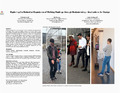
[en] Walking meetings are a promising way to reduce unhealthy sedentary behavior at the office. Some aspects of walking meetings are however hard to assess using traditional research approaches that do not account well for the embodied experience of walking meetings. We conducted a series of 16 bodystorming sessions, featuring unusual walking meeting situations to engage participants (N=45) in a reflective experience. After each bodystorming, participants completed three tasks: a body map, an empathy map, and a rating of workload using the NASA-TLX scale. These embodied explorations provide insights on key themes related to walking meetings: material and tools, physical and mental demand, connection with the environment, social dynamics, and privacy. We discuss the role of technology and opportunities for technology-mediated walking meetings. We draw implications for the design of walking meeting technologies or services to account for embodied experiences, and the individual, social, and environmental factors at play.
Disciplines :
Sciences sociales & comportementales, psychologie: Multidisciplinaire, généralités & autres
Auteur, co-auteur :
Jacob, Melodie
Damen, Ida
LALLEMAND, Carine ; University of Luxembourg > Faculty of Humanities, Education and Social Sciences (FHSE) > Department of Behavioural and Cognitive Sciences (DBCS)
Co-auteurs externes :
yes
Langue du document :
Anglais
Titre :
Exploring the Embodied Experience of Walking Meetings through Bodystorming – Implications for Design
Date de publication/diffusion :
février 2023
Nom de la manifestation :
TEI'23 Seventeenth International Conference on Tangible, Embedded, and Embodied Interaction
Lieu de la manifestation :
Warsaw, Pologne
Date de la manifestation :
from 26-02-2023 to 01-03-2023
Manifestation à portée :
International
Titre de l'ouvrage principal :
TEI'23 Seventeenth International Conference on Tangible, Embedded, and Embodied Interaction
Arlie Adkins, Jennifer Dill, Gretchen Luhr, and Margaret Neal. 2012. Unpacking Walkability: Testing the Influence of Urban Design Features on Perceptions ofWalking Environment Attractiveness. Joumal of Urban Design 17, 4 (November 2012), 499-510. DOI:https://doi.org/10.1080/13574809.2012.706365
Aino Ahtinen, Eeva Andrejeff, Christopher Harris, and Kaisa Väänänen. 2017. Let's walk at work-Persuasion through the brainwolk walking meeting app. In Proceedings of the 21 st Intemational Academic Mindtrek Conference, AcademicMindtrek 2017 , Association for Computing Machinery, Inc, 73-82. DOI:https://doi.ory'10.1145 3131085.3131098
Aino Ahtinen, EevaAndrejeff, and Kaisa Väänänen. 2016. Brainwolk-A Mobile Technology Mediated Walking Meeting Concept for Wellbeing and Creativity at Work. In Proceedings of the 15th Intemational Conference on Mobile and Ubiquitous Multimedia, ACM, New York, NY, USA, 307-309. DOI:https://doi.org/10.1145/3012709.3016062
Aino Ahtinen, EevaAndrejeff, Maiju Vuolle, and Kaisa Väänänen. 2016. Walk as You Work-User Study and Design Implications for Mobile Walking Meetings. In Proceedings of the 9th Nordic Conference on Human-Computer Interaction, ACM, New York, NY, USA, 1-10. DOI:https://doi.org/10.1145 2971485.2971510
Andrew W. Bailey, Garrett Allen, Josh Hemdon, and Christian Demastus. 2018. Cognitive benefits of walking in natural versus built environments. World Leisure Joumal 60, 4 (October 2018), 293-305. DOI:https doi.org/10.1080/16078055.2018.1445025
Agnes E. van den Berg and Femke Beute. 2021. Walk it off The effectiveness of walk and talk coaching in nature for individuals with bumout-And stress-related complaints. Journal of Environmental Psychology 76, (August 2021). DOI:https://doi.org/10.1016/j.jenvp.2021.101641
Anna Bomioli. 2022. The walking meeting: opportunities for better health and sustainability in post-COVTD-19 cities. Cities and Health (2022). DOI:https://doi.org/10.1080/23748834.2022.2050103
Tjeu van Bussel, Roy van den Heuvel, and Carine Lallemand. 2022. Habilyzer: Empowering Office Workers to Investigate their Working Habits using an Open Ended Sensor Kit. In Extended Abstracts of the 2022 CHI Conference on Human Factors in Computing Systems (CHI EA '22), ACM, New York, NY, USA. DOI:https://doi.org/10.1145/3491101.3519849
Hancheng Cao, Chia-Jung Lee, Shamsi Iqbal, Mary Czerwinski, Priscilla N Y Wong, Sean Rintel, Brent Hecht, Jaime Teevan, and Longqi Yang. 2021. Large Scale Analysis of Multitasking Behavior During Remote Meetings. In Proceedings of the 2021 CHI Conference on Human Factors in Computing Systems, ACM, New York, NY, USA, 1-13. DOI:https://doi.org/10.1145/3411764.3445243
Russell Clayton, Christopher Thomas, and Jack Smothers. 2015. How to Do Walking Meetings Right. Harvard Business Review. Retrieved May 4, 2022 from https://hbr.org/2015/08/'how-To-do-wa1king-meetings-right
Pieter Coenen, Nicholas Gilson, Genevieve N. Healy, David W. Dunstan, and Leon M. Straker. 2017. A qualitative review of existing national and intemational occupational safety and health policies relating to occupational sedentary behaviour. Applied Ergonomics 60, 320-333. DOI:https://doi.org/10.1016/j.apergo.2016.12.010
Ida Damen, Rens Brankaert, Carl Megens, Pieter van Wesemael, Aamout Brombacher, and Steven Vos. 2018. Let's walk and talk: A design case to integrate an active lifestyle into daily office life. In Conference on Human Factors in Computing Systems-Proceedings, Association for Computing Machinery. DOI:https://doi.ory'10.1145/3170427.3174353
Ida Damen, Aamout Brombacher, Pieter van Wesemael, Rens Brankaert, Carine Lallemand, J.G. Brombacher, and Steven Vos. 2019. WorkWa1k: A case study to integrate an active lifestyle into daily office life. In Walk21 Conference
Ida Damen, Hans Brombacher, Carine Lallemand, Rens Brankaert, Aamout Brombacher, Pieter van Wesemael, and Steven Vos. 2020. A scoping review of digital tools to reduce sedentary behavior or increase physical activity in knowledge workers. Intemational Journal of Environmental Research and Public Health 17, 2 (2020). DOI:https://doi.org/10.3390/ijerph17020499
Ida Damen, Anika Kok, Bas Vmk, Hans Brombacher, Steven Vos, and Carine Lallemand. 2020. The hub: Facilitating walking meetings through a netvvork of interactive devices. In DIS 2020 Companion-Companion Publication of the 2020 ACM Designing Interactive Systems Conference, Association for Computing Machinery, New York, NY, USA, 19-24. DOI:https://doi.org/10.1145/3393914.3395876
Ida Damen, Carine Lallemand, Rens Brankaert, Aamout Brombacher, Pieter van Wesemael, and Steven Vos. 2020. Understanding Walking Meetings: Drivers and Barriers. In Proceedings of the 2020 CHI Conference on Human Factors in Computing Systems, Association for Computing Machinery, New York, NY, USA, 1-14. DOI:https://doi.or10.1145/3313831.3376141
Ida Damen, Daphne Menheere, Carine Lallemand, and Steven Vos. 2020. Ivy: Reading a critical design for sedentary behavior in the office context. In DIS 2020 Companion-Companion Publication of the 2020 ACM Designing Interactive Systems Conference, Association for Computing Machinery, New York, NY, USA, 7-12. DOI:https://doi.or10.1145/3393914.3395893
Ida Damen, Ingmar Nieuweboer, Hans Brombacher, Pieter van Wesemael, Steven Vos, and Carine Lallemand. 2021. The Offce Jungle: Exploring Unusual Ways of Working though Bodily Experimentations. In DIS 2021 Proceedings of the 2021 ACM Designing Interactive Systems Conference: Nowhere and Everywhere, Association for Computing Machinery, New York, NY, USA, 466-477. DOI:https://doi.or10.1145/3461778.3462062
Ida Damen, Steven Vos, and Carine Lallemand. 2021. The Hubs: Design Insights for Walking Meeting Technology. In Book Series: Lecture Notes in Computer Science, Springer Intemational Publishing, 610-629. DOI:https://doi.org/10.1007 978-3-030-85610-6 35
Verena Distler, Matthias Fassl, Hana Habib, Katharina Krombholz, Gabriele Lenzini, Carine Lallemand, Lonie Faith Cranor, and Vmcent Koenig. 2021. A Systematic Literature Review of Empirical Methods and Risk Representation in Usable Privacy and Security Research. ACM Transactions on Computer-Human Interaction 28. DOI:https://doi.org/10.1145/3469845
Bruna Ferreira, Williamson Silva, Edson Oliveira, and Tayana Conte. 2015. Designing personas with empathy map. In Proceedings of the International Conference on Software Engineering and Knowledge Engineering, SEKE, Knowledge Systems Institute Graduate School, 501-505. DOI:https://doi.org/10.18293/SEKE2015-152
Sarah Forberger, Frauke Wichmann, and Chiara Nicoletta Comito. 2022. Nudges used to promote physical activity and to reduce sedentary behaviour in the workplace: Results of a scoping review. Preventive Medicine 155. DOI:https://doi.org/10.1016/j.ypmed.2021.106922
Stephen J Gould. 1995. Researcher Introspection as a Method in Consumer Research: Applications, Issues, and Implications. Source: Joumal of Consumer Research 21, 4 (1995), 719-722. Retrieved from https://about.jstor.org/terrns
Luke Haliburton and Albrecht Schmidt. 2020. Technologies for Healthy Work. Interactions, 64-66
Luke Haliburton, Pawel W. Wozniak, Albrecht Schmidt, and Jasmin Niess. 2021. Charting the Path: Requirements and Constraints for Technology-Supported Walking Meetings. Proceedings of the ACM on Human Computer Interaction 5, CSCW2 (October 2021). DOI:https://doi.org/10.1145/3476088
Sandra G Hart and Lowell E Staveland. 1988. Development of NASA-TLX (Task Load Index)" Results of Empirical and Theoretical Research. In Human Mental Workload, P. A. Hancock and N. Meshkati (eds.). North Holland Press, Amsterdam, 239-250
Heiko Hecht, Robin Welsch, Jana Viehoff, and Matthew R. Longo. 2019. The shape ofpersonal space. Acta Psychologica 193, (February 2019), 113-122. DOI:https://doi.org/10.1016 j.actpsy.2018.12.009
Roy van den Heuvel, Ida Damen, Rens Brankaert, and Steven Vos. 2021. Advancing Digital Behavior Change Interventions by Exploring a Calendar-Based Suggestion System. In European Conference on Cognitive Ergonomics 2021, ACM, New York, W, LISA, 1-7. DOI:https://doi.org/10.1145/3452853.3452866
Kristina Höök, Baptiste Caramiaux, Cumhur Erkut, Jodi Forlizzi, Nassrin Hajinejad, Michael Haller, Caroline Hummels, Katherine Isbister, Martin Jonsson, George Khut, Lian Loke, Danielle Lottridge, Patrizia Marti, Edward Melcer, Florian Möller, Marianne Petersen, Thecla Schiphorst, Elena Segura, Anna Stahl, Dag Svanas, Jakob Tholander, and Helena Tobiasson. 2018. Embracing First-Person Perspectives in Soma-Based Design. Informatics 5, 1 (February 2018), 8. DOI:https://doi.org/10.3390 informatics5010008
Yitong Huang, Steve Benford, and Holly Blake. 2019. Digital interventions to reduce sedentary behaviors of office workers: Scoping review. Journal of Medical Intemet Research 21, 2 (2019), 1-19. DOI:https doi.org/10.2196/11079
Mary Carol R. Hunter, Brenda W. Gillespie, and Sophie Yu Pu Chen. 2019. Urban nature experiences reduce stress in the context of daily life based on salivary biomarkers. Frontiers in Psychology 10, APR (2019). DOI:https: doi.o@10.3389/fpsyg.2019.00722
Paul Kelly, Chloé Williamson, Ailsa G. Niven, Ruth Hunter, Nanette Mutrie, and Justin Richards. 2018. Walking on sunshine: Scoping review of the evidence for walking and mental health. British Journal of Sports Medicine 52, 800-806. DOI:https://doi.ory'10.1136/bjsports-2017-098827
Harold W Kohl, Cora Lynn Craig, Estelle Victoria Lambert, Shigeru Inoue, Jasem Ramadan Alkandari, Grit Leetongin, and Sonja Kahlmeier. 2012. The pandemic of physical inactivity: global action for public health. The Lancet 380, 9838 (July 2012), 294-305. DOI:https://doi.org/10.1016/S0140-6736(12)60898-8
I-Min Lee, Eric J Shiroma, Felipe Lobelo, Pekka Puska, Steven N Blair, and Peter T Katzmarzyk. 2012. Effect ofphysical inactivity on major non-communicable diseases worldwide: An analysis of burden of disease and life expectancy. The Lancet 380, 9838 (July 2012), 219-229. DOI:https://doi.org/10.1016/S0140-6736(12)61031-9
Kristina Mah, Lian Loke, and Luke Hespanhol. 2021. Towards a Contemplative Research Framework for Training Self-Observation in HCI: A Study of Compassion Cultivation. ACM Transactions on Computer-Human Interaction 28, 6 (December 2021). DOI:https://doi.org/10.1145/3471932
Marily Oppezzo and Daniel L. Schwartz. 2014. Give your ideas some legs: The positive effect of walking on creative thinking. Joumal of Experimental Psychology: Leaming Memory and Cognition 40, 4 (2014), 1142-1152. DOI:https://doi.org/10.1037 a0036577
Antti Oulasvirta, Esko Kurvinen, and Tomi Kankainen. 2003. Understanding contexts by being there: Case studies in bodystonning. In Personal and Ubiquitous Computing, Springer-Verlag London Ltd, 125-134. DOI:https://doi.ory'10.1007 s00779-003-0238-7
Loes van Renswouw, Steven Vos, Pieter van Wesemael, and Carine Lallemand. 2021. Exploring the Design Space of InterActive Urban Environments: Triggering physical activity through embedded technology. In DIS 2021-Proceedings of the 2021 ACM Designing Interactive Systems Conference: Nowhere and Everywhere, Association for Computing Machinery, Inc, 955-969. DOI:https://doi.org/10.1145/3461778.3462137
Stephanie Revell and John McLeod. 2016. Experiences of therapists who integrate walk and talk into their professional practice. Counselling and Psychotherapy Research 16, 1 (March 2016), 35-43. DOI:https://doi.org/10.1002/capr.12042
Dennis Schleicher, Peter Jones, and Oksana Kachur. 2010. Bodystorming as embodied designing. Interactions 17, 6 (2010), 47-51. DOI:https://doi.org/10.1145/1865245.1865256
Elena Märquez Segura, Laia Turmo Vidal, and Asreen Rostami. 2016. Bodystorming for movement-based interaction design. Human Technology 12, 2 (2016), 193-251. DOI:https://doi.org/10.17011/ht\urn.201611174655
Rob Shields, Edmar Joaquim Gomes da Silva, Thiago Lima e Lima, and Nathalia Osorio. 2021. Walkability: A review of trends. Joumal of Urbanism (2021). DOI:https://doi.org/10.1080/17549175.2021.1936601
Richard Shusterman. 2008. Body consciousness : A philosophy of mindfulness and somaesthetics. Cambridge University Press
Michael Southworth. 2005. Designing the Walkable City. Journal ofUrban Planning and Development, 131, 4 (2005). DOI:https://doi.o@10.1061 ASCE0733-94882005131:4246
Keri K. Stephens and Jennifer Davis. 2009. The social influences on electronic multitasking in organizational meetings. Management Communication Quarterly 23, 1 (August 2009), 63-83. DOI:https://doi.org/10.1177/0893318909335417
World Health Organization. 2018. Global action plan on physical activity 2018-2030: more active people for a healthier world. Geneva. Retrieved June 6, 2022 from https://apps.who.int/iris/bitstream/handle/10665/272722/9789241514187-eng.pdf
World Health Organization. 2021. Planning healthy and sustainable meetings A practical guide Third edition. Geneva. Retrieved from http w-w-w. who.int/about/licensing
Haian Xue and Pieter M.A. Desmet. 2019. Researcher introspection for experience-driven design research. Design Studies 63, (July 2019), 37-64. DOI:https://doi.org/10.1016/j.destud.2019.03.001