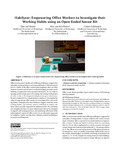
[en] Office work presents health and wellbeing challenges, triggered by unhealthy working habits or environmental factors. While technologies for vitality in the office context gain popularity, they are often solution-focused and fall short in acknowledging personal needs. Building on approaches from personal informatics, we see value in opening up the design space of tracking and sensing technologies for office workers. We designed and deployed an open-ended sensor kit and conducted two complementary studies to investigate the value of empowering office workers to investigate their own working habits. Findings show that Habilyzer triggers curiosity about working habits, and wireless sensors contribute to inquire into those habits, possibly supported by additional tools. We contribute new insights into how an open-ended sensor kit can be designed to support self-tracking practices and underlying reflections in the underexplored context of office work. It is an alternative approach to workplace vitality, moving from solution-oriented technologies to inquiry-enabling tools.
Disciplines :
Sciences sociales & comportementales, psychologie: Multidisciplinaire, généralités & autres
Auteur, co-auteur :
van Bussel, Tjeu
van den Heuvel, Roy
LALLEMAND, Carine ; University of Luxembourg > Faculty of Humanities, Education and Social Sciences (FHSE) > Department of Behavioural and Cognitive Sciences (DBCS)
Co-auteurs externes :
yes
Langue du document :
Anglais
Titre :
Habilyzer: Empowering Office Workers to Investigate their Working Habits using an Open-Ended Sensor Kit
Date de publication/diffusion :
avril 2022
Nom de la manifestation :
ACM CHI 2022 Conference on Human Factors in Computing Systems
Date de la manifestation :
From 29-04-2022 to 05-05-2022
Manifestation à portée :
International
Titre de l'ouvrage principal :
Proceedings of the Extended Abstracts of the 2022 CHI Conference on Human Factors in Computing Systems
Philomena M. Bluyssen, Sabine Janssen, Linde H. van den Brink, and Yvonne de Kluizenaar. 2011. Assessment of wellbeing in an indoor ofce environment. Building and Environment 46, 12: 2632-2640. DOI:10.1016/j.buildenv.2011.06.026
Yannick Brouwer and Stijn Zoontjens. 2016. Totem Pop. Retrieved September 29, 2021 from https://yannickbrouwer.nl/work/totempop/index.html
Eun Kyoung Choe, Bongshin Lee, Haining Zhu, Nathalie Henry Riche, and Dominikus Baur. 2017. Understanding self-refection: How people refect on personal data through visual data exploration. PervasiveHealth: Pervasive Computing Technologies for Healthcare, Association for Computing Machinery New York, NY, USA, 173-182. DOI:10.1145/3154862.3154881.
Young Chul Chung, Nanna Gorm, Irina Shklovski, and Sean A. Munson. 2017. Finding the Right Fit: Understanding Health Tracking in Workplace Wellness Programs. Proceedings of the 2017 CHI Conference on Human Factors in Computing Systems, Association for Computing Machinery New York, NY, USA. DOI:10.1145/3025453.3025510.
Nazli Cila, Iskander Smit, Elisa Giaccardi, and Ben Kröse. 2017. Products as Agents: Metaphors for Designing the Products of the IoT Age. Proceedings of the 2017 CHI Conference on Human Factors in Computing Systems, Association for Computing Machinery New York, NY, USA, 448-459. DOI:10.1145/3025453.3025797.
Ida Damen, Hans Brombacher, Carine Lallemand, et al. 2020. A scoping review of digital tools to reduce sedentary behavior or increase physical activity in knowledge workers. International Journal of Environmental Research and Public Health 17, 2. DOI:10.3390/ijerph17020499
Ida Damen, Lidewij Heerkens, Annabel Van Den Broek, et al. 2020. PositionPeak: Stimulating position changes during meetings. Extended Abstracts of the 2020 CHI Conference on Human Factors in Computing Systems (CHI EA '20), Association for Computing Machinery New York, NY, USA, 1-8. DOI:10.1145/3334480.3383054.
Ida Damen, Daphne Menheere, Carine Lallemand, and Steven Vos. 2020. Ivy: Reading a critical design for sedentary behavior in the ofce context. DIS 2020 Companion -Companion Publication of the 2020 ACM Designing Interactive Systems Conference, Association for Computing Machinery New York, NY, USA, 7-12. DOI:10.1145/3393914.3395893.
Ida Damen, Ingmar Nieuweboer, Hans Brombacher, Pieter Van Wesemael, Steven Vos, and Carine Lallemand. 2021. The Ofce Jungle: Exploring Unusual Ways of Working through Bodily Experimentations. DIS 2021 -Proceedings of the 2021 ACM Designing Interactive Systems Conference: Nowhere and Everywhere, Association for Computing Machinery New York, NY, USA, 466-477. DOI:10.1145/3461778.3462062.
Ida Damen, Steven Vos, and Carine Lallemand. 2021. The Hubs: Design Insights for Walking Meeting Technology. Book Series: Lecture Notes in Computer Science, Springer International Publishing, 610-629. DOI:10.1007/978-3-030-85610-6-35.
Nediyana Daskalova, Karthik Desingh, Alexandra Papoutsaki, Diane Schulze, Han Sha, and Jef Huang. 2017. Lessons Learned from Two Cohorts of Personal Informatics Self-Experiments. Proceedings of the ACM on Interactive, Mobile, Wearable and Ubiquitous Technologies, Association for Computing Machinery New York, NY, USA, 1-22. DOI:10.1145/3130911.
Nediyana Daskalova, Eindra Kyi, Kevin Ouyang, et al. 2021. Self-e: Smartphone-supported guidance for customizable self-experimentation. Proceedings of the 2021 CHI Conference on Human Factors in Computing Systems (CHI '21), Association for Computing Machinery New York, NY, USA. DOI:10.1145/3411764.3445100.
Nediyana Daskalova, Jina Yoon, Yibing Wang, et al. 2020. SleepBandits: Guided Flexible Self-Experiments for Sleep. Proceedings of the 2020 CHI Conference on Human Factors in Computing Systems, Association for Computing Machinery New York, NY, USA, 1-13. DOI:10.1145/3313831.3376584.
Teresa Denefeh, Arne Berger, Albrecht Kurze, Andreas Bischof, and Christopher Frauenberger. 2019. Sensorstation: Exploring simple sensor data in the context of a shared apartment. DIS 2019 -Proceedings of the 2019 ACM Designing Interactive Systems Conference, Association for Computing Machinery New York, NY, USA, 683-695. DOI:10.1145/3322276.3322309.
Daniel A. Epstein, Clara Caldeira, Mayara Costa Figueiredo, et al. 2020. Mapping and Taking Stock of the Personal Informatics Literature. Proceedings of the ACM on Interactive, Mobile, Wearable and Ubiquitous Technologies, Association for Computing Machinery New York, NY, USA. DOI:10.1145/3432231.
Daniel A. Epstein, An Ping, James Fogarty, and Sean A. Munson. 2015. A lived informatics model of personal informatics. UbiComp 2015 -Proceedings of the 2015 ACM International Joint Conference on Pervasive and Ubiquitous Computing, Association for Computing Machinery New York, NY, USA, 731-742. DOI:10.1145/2750858.2804250.
WilliamW. Gaver, Jacob Beaver, and Steve Benford. 2003. Ambiguity as a resource for design. Proceedings of the 2003 CHI Conference on Human Factors in Computing Systems, ACM New York, NY, USA, 233-240. DOI:10.1145/642611.642653.
Roy Van Den Heuvel, Tjeu van Bussel, and Carine Lallemand. 2022. Habilyzer: A User-Driven Open-Ended Sensor Kit for Ofce Workers. Extended Abstracts of the 2022 CHI Conference on Human Factors in Computing Systems (CHI EA '22), ACM New York, NY, USA. DOI:https://doi.org/10.1145/3491101.3519884.
Steven Houben, Connie Golsteijn, Sarah Gallacher, et al. 2016. Physikit: Data Engagement Through Physical Ambient Visualizations in the Home. Proceedings of the 2016 CHI Conference on Human Factors in Computing Systems, Association for Computing Machinery New York, USA, 1608-1619. DOI:10.1145/2858036.2858059.
Samuel Huron, Sheelagh Carpendale, Alice Thudt, Anthony Tang, and Michael Mauerer. 2014. Constructive visualization. DIS 2014 -Proceedings of the 2014 ACM Conference on Designing Interactive Systems, Association for Computing Machinery New York, NY, USA, 433-442. DOI:10.1145/2598510.2598566.
Yvonne Jansen, Pierre Dragicevic, Petra Isenberg, et al. 2015. Opportunities and challenges for data physicalization. Proceedings of the 2015 CHI Conference on Human Factors in Computing Systems, Association for Computing Machinery New York, NY, USA, 3227-3236. DOI:10.1145/2702123.2702180.
Ravi Karkar. 2018. Designing for diagnostic self-Tracking. UbiComp/ISWC 2018 Adjunct Proceedings of the 2018 ACM International Joint Conference on Perva-sive and Ubiquitous Computing and Proceedings of the 2018 ACM International Symposium onWearable Computers, Association for Computing Machinery New York, NY, USA, 516-521. DOI:10.1145/3267305.3267314.
Ravi Karkar, James Fogarty, Julie A. Kientz, Sean A. Munson, Roger Vilardaga, and Jasmine Zia. 2015. Opportunities and challenges for self-experimentation in self-Tracking. UbiComp and ISWC 2015 -Proceedings of the 2015 ACM International Joint Conference on Pervasive and Ubiquitous Computing and the Proceedings of the 2015 ACM International Symposium on Wearable Computers, Association for Computing Machinery New York, NY, USA, 991-996. DOI:10.1145/2800835.2800949.
Da Jung Kim, Yeoreum Lee, Saeyeong Rho, and Youn Kyung Lim. 2016. Design opportunities in three stages of relationship development between users and self-Tracking devices. Proceedings of the 2016 CHI Conference on Human Factors in Computing Systems, Association for Computing Machinery New York, NY, USA, 699-703. DOI:10.1145/2858036.2858148.
Janne van Kollenburg, Sander Bogers, Heleen Rutjes, Eva Deckers, Joep Frens, and Caroline Hummels. 2018. Exploring the value of parent-Tracked baby data in interactions with healthcare professionals: A data-enabled design exploration. Proceedings of the 2018 CHI Conference on Human Factors in Computing Systems, Association for Computing Machinery New York, NY, USA, 1-12. DOI:10.1145/3173574.3173871.
Janne van Kollenburg and Sander Bogers. Universiteit Eindhoven. 2019. Data-enabled design: A situated design approach that uses data as creative material when designing for intelligent ecosystems.
Malgorzata W. Kozusznik, José M. Peiró, Aida Soriano, and Miriam Navarro Escudero. 2018. "Out of Sight, Out of Mind?": The Role of Physical Stressors, Cognitive Appraisal, and Positive Emotions in Employees' Health. Environment and Behavior 50, 1: 86-115. DOI:10.1177/0013916517691323
Carine Lallemand and Maud Oomen. 2022. The Candy Workshop: Supporting Rich Sensory Modalities in Constructive Data Physicalization. Extended Abstracts of the 2022 CHI Conference on Human Factors in Computing Systems (CHI EA '22), ACM New York, NY, USA. DOI:https://doi.org/10.1145/3491101.3519648.
Amanda Lazar, Christian Koehler, Theresa Jean Tanenbaum, and David H. Nguyen. 2015. Why we use and abandon smart devices. UbiComp 2015 -Proceedings of the 2015 ACM International Joint Conference on Pervasive and Ubiquitous Computing, Association for Computing Machinery New York, NY, USA, 635-646. DOI:10.1145/2750858.2804288.
Ian Li, Anind Dey, and Jodi Forlizzi. 2010. A stage-based model of personal informatics systems. Proceedings of the 2010 CHI Conference on Human Factors in Computing Systems, Association for Computing Machinery New York, NY, USA, 557-566. DOI:10.1145/1753326.1753409.
Youn-kyung Lim, Daesung Kim, Jaesung Jo, and Jong-bumWoo. 2013. Discovery-Driven Prototyping for User-Driven Creativity. IEEE Pervasive Computing 12, 3: 74-80. DOI:10.1109/MPRV.2012.57
Anna Puig-Ribera, Iván Martínez-Lemos, Maria Giné-Garriga, et al. 2015. Self-reported sitting time and physical activity: Interactive associations with mental well-being and productivity in ofce employees. BMC Public Health 15, 1: 1-10. DOI:10.1186/s12889-015-1447-5
Mahbub Rashid and Craig Zimring. 2008. A review of the empirical literature on the relationships between indoor environment and stress in health care and ofce settings: Problems and prospects of sharing evidence. Environment and Behavior 40, 2: 151-190. DOI:10.1177/0013916507311550
John Rooksby, Mattias Rost, Alistair Morrison, and Matthew Chalmers. 2014. Per-sonal Tracking as Lived Informatics John. Proceedings of the 2014 CHI Conference on Human Factors in Computing Systems, Association for Computing Machinery New York, NY, USA, 9016-9016.
Sjoerd Stamhuis, Hans Brombacher, Steven Vos, and Carine Lallemand. 2021. Ofce Agents: Personal Ofce Vitality Sensors with Intent. Extended Ab-stracts of the 2021 CHI Conference on Human Factors in Computing Systems (CHI EA '21), Association for Computing Machinery New York, NY, USA. DOI:10.1145/3411763.3451559.
Alice Thudt, Uta Hinrichs, Samuel Huron, and Sheelagh Carpendale. 2018. Self-refection and personal physicalization construction. Proceedings of the 2018 CHI Conference on Human Factors in Computing Systems, Association for Computing Machinery New York, NY, USA, 1-13. DOI:10.1145/3173574.3173728.
Kendra A.Wannamaker, Sandeep Zechariah George Kollannur, Marian Dörk, and Wesley Willett. 2021. I/O Bits: User-Driven, Situated, and Dedicated Self-Tracking. DIS 2021 -Proceedings of the 2021 ACM Designing Interactive Systems Conference: Nowhere and Everywhere, Association for Computing Machinery New York, NY, USA, 523-537. DOI:10.1145/3461778.3462138.
Christina Wohlers, Martina Hartner-Tiefenthaler, and Guido Hertel. 2019. The Relation Between Activity-Based Work Environments and Ofce Work-ers' Job Attitudes and Vitality. Environment and Behavior 51, 2: 167-198. DOI:10.1177/0013916517738078