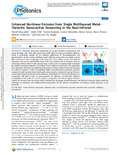
Abstract :
[en] Harmonic generation mechanisms are of great interest in nanoscience and
nanotechnology, since they allow generating visible light by using near-infrared radiation,
which is particularly suitable for its countless applications in bionanophotonics and
optoelectronics. In this context, multilayer metal−dielectric nanocavities are widely used for
light confinement and waveguiding at the nanoscale. They exhibit intense and localized
resonances that can be conveniently tuned in the near-infrared and are therefore ideal for
enhancing nonlinear effects in this spectral range. In this work, we experimentally investigate
the nonlinear emission properties of multilayer metal−dielectric nanocavities. By engineering
their absorption efficiency and exploiting their intrinsic interface-induced symmetry breaking,
we achieve an almost 2 orders of magnitude higher second-harmonic generation efficiency
compared to gold nanostructures featuring the same geometry and optical resonant behavior.
In particular, while both the third-order nonlinear susceptibility and conversion efficiency are
comparable with those of the Au nanoresonators, we estimate a second-order nonlinear
susceptibility of the order of 1 pm/V, which is comparable with that of typical nonlinear
crystals. We envision that our system, which combines the advantages of both plasmonic and dielectric materials, might enable the realization of composite and multifunctional nanosystems for the efficient manipulation of nonlinear optical processes at the nanoscale.
Scopus citations®
without self-citations
35