Abstract :
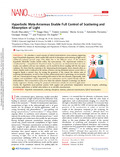
[en] We introduce a novel concept of hybrid metal-dielectric meta-antenna supporting type II hyperbolic dispersion, which enables full control of absorption and scattering of light in the visible/near-infrared spectral range. This ability lies in the different nature of the localized hyperbolic Bloch-like modes excited within the meta-antenna. The experimental evidence is corroborated by a comprehensive theoretical study. In particular, we demonstrate that two main modes, one radiative and one non-radiative, can be excited by direct coupling with the free-space radiation. We show that the scattering is the dominating electromagnetic decay channel, when an electric dipolar mode is induced in the system, whereas a strong absorption process occurs when a magnetic dipole is excited. Also, by varying the geometry of the system, the relative ratio of scattering and absorption, as well as their relative enhancement and/or quenching, can be tuned at will over a broad spectral range, thus enabling full control of the two channels. Importantly, both radiative and nonradiative modes supported by our architecture can be excited directly with far-field radiation. This is observed to occur even when the radiative channels (scattering) are almost totally suppressed, thereby making the proposed architecture suitable for practical applications. Finally, the hyperbolic meta-antennas possess both angular and polarization independent structural integrity, unlocking promising applications as hybrid meta-surfaces or as solvable nanostructures.
Scopus citations®
without self-citations
63