working memory; short-term memory; phonological awareness
Abstract :
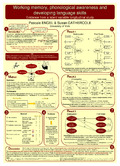
[en] The relationship between working memory, verbal short-term memory, phonological awareness, and developing language skills was explored longitudinally in children growing up in a multilingual society. A sample of 121 children from Luxembourg were followed from the end of Kindergarten to 1st Grade, and completed multiple assessments of verbal short-term memory, complex working memory, phonological awareness, native and foreign vocabulary knowledge, language comprehension, and reading.
Results indicate that relations between the measures were best characterized by a model consisting of two related but separable constructs – corresponding to verbal short-term memory and the central executive – that were distinct from phonological awareness. The data further showed that assessments of verbal short-term memory in Kindergarten significantly predicted vocabulary knowledge and comprehension in native and foreign languages one year later: Central executive and verbal short-term memory measures in Kindergarten were significantly associated with reading in 1st Grade and phonological awareness, indexed by rhyme detection, did not predict any of the language constructs one year later.
The findings lend strong support to the position that verbal short-term memory is one of the main contributors to new word learning in both native and non-native languages by supporting the formation of stable phonological representations of new words in long-term memory. Verbal short-term memory also seems to play a significant role in the syntactic comprehension of sentences. The heard material might be kept active in verbal short-term memory while the child is listening to the sentence and processing it for comprehension. Finally working memory appears to make significant contributions to reading development. One explanation of these findings is that literacy classroom activities often impose heavy demands on working memory, the capacity of which therefore has a direct effect on the frequency of task failure or success in these classroom activities which consequently influences the rate of learning.
Disciplines :
Theoretical & cognitive psychology
Author, co-author :
ENGEL DE ABREU, Pascale ; University of Luxembourg > Faculty of Language and Literature, Humanities, Arts and Education (FLSHASE) > Educational Measurement and Applied Cognitive Science (EMACS)
Gathercole, S
Language :
English
Title :
Working memory, phonological awareness, and developing language skills
Publication date :
July 2008
Event name :
Cognitive Development, Mechanisms, and Constraints, Archives Jean Piaget